2021-2023
The Great Exodus
Crisis, protests and the volcano route: the largest departure of Cubans in history
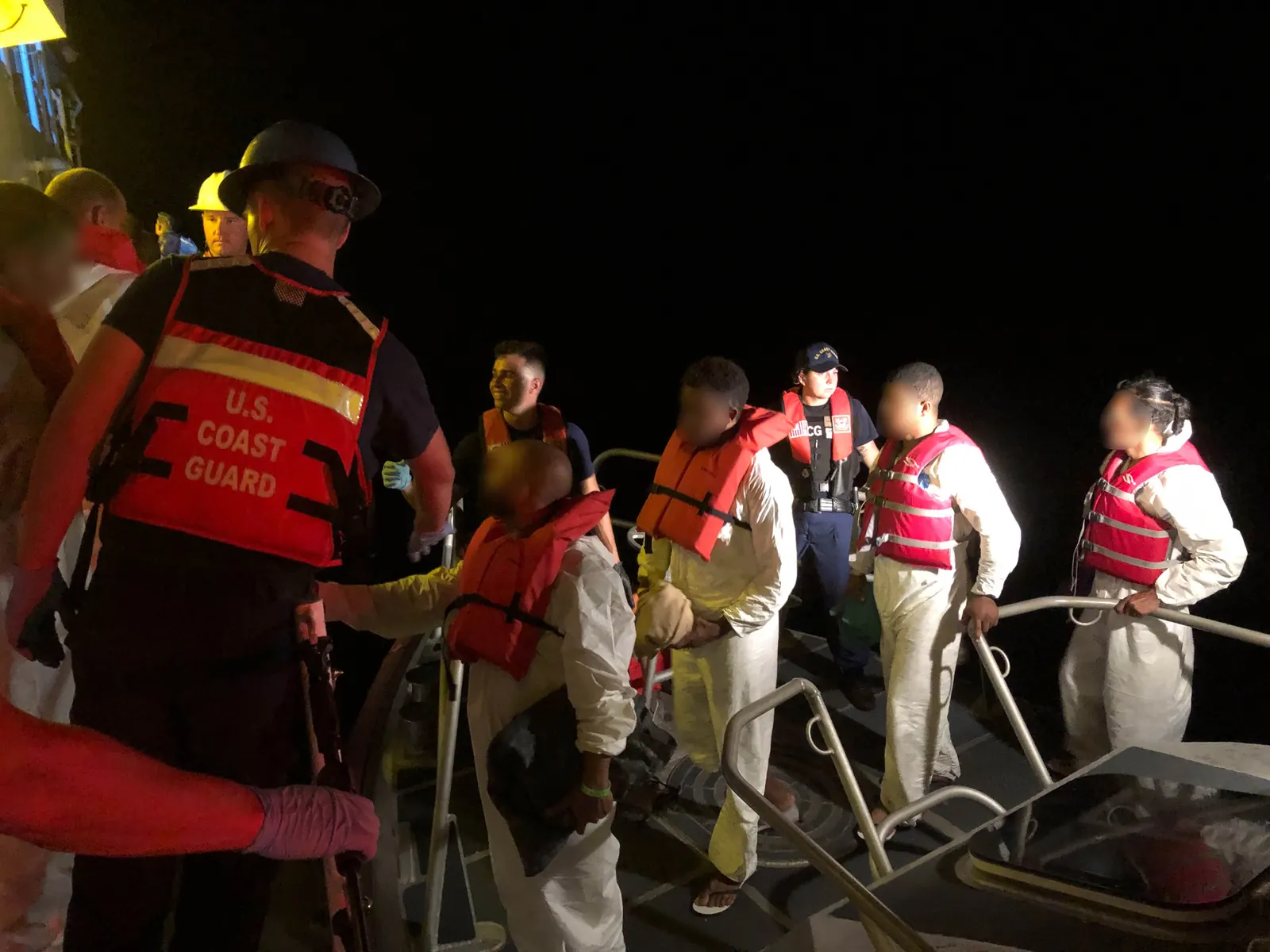
Between October 1, 2021, and September 30, 2023, U.S. Customs and Border Protection (CBP) recorded 424,894 encounters with Cuban citizens, the vast majority at the border with Mexico1. The figure counts episodes, not people, because someone can be detained more than once, but even with that caveat nothing in the history of Cuban emigration compares with it. In January 2023, the Department of Homeland Security (DHS) wrote in the Federal Register that Cubans were "fleeing the island in record numbers, eclipsing the mass exodus of Cuban migrants seen during the Mariel exodus of 1980"2. Unlike Mariel or the rafter crisis, this time most people did not take to the sea: many flew to Managua and traveled overland through Central America and Mexico to the Rio Grande3.
"This is the largest number of people trying to leave Cuba since the great exodus of decades ago [...] I would dare say it is the biggest migration crisis in the history of Cuba." (translated from Spanish) Jorge Duany, director of the Cuban Research Institute at Florida International University (FIU), to Voice of America, September 20223
An Economy in Free Fall
The Cuban government reported that gross domestic product shrank 10.9% in 2020, the year the covid-19 pandemic shut down tourism, and grew only 1.3% in 20214. On January 1, 2021, the monetary unification known on the island as Tarea Ordenamiento took effect: the convertible Cuban peso (CUC), pegged to the dollar since 1994, began to be withdrawn from circulation and a single official rate of 24 pesos per dollar was set5. The reform had been postponed for years and it sent prices soaring. The Congressional Research Service (CRS) cited inflation estimates of between 150% and 500% for 20214.
Blackouts came on top of shortages of food and medicine. In its January 2023 analysis, DHS described Cubans who "wait in lines for hours to receive subsidized cooking oil" and a poverty worsened by the pandemic; in September 2022, a prolonged blackout after Hurricane Ian had set off protests in Havana and other cities2.
July 11
On Sunday, July 11, 2021, thousands of Cubans took to the streets in many parts of the country. Human Rights Watch (HRW) described them as the largest demonstrations against the government since the 1959 revolution: people protested the lack of freedoms, the shortages of food and medicine and the handling of the pandemic6. The protests came to be known by an abbreviation, 11J.
The response was mass detention. According to the Cuban human rights group Cubalex, cited by HRW, more than 1,400 people were detained; one protester died, apparently at the hands of the police6. Several organizations recorded internet shutdowns across the country and restrictions on social media and messaging services2.
On January 25, 2022, the Attorney General's Office reported through the newspaper Granma that 790 people had been charged over the events: 710 had already been sent to trial, 172 had been convicted and 55 of the defendants were between 16 and 18 years old7. One year after the protests, HRW counted more than 380 confirmed convictions, many for "sedition," with prison terms of up to 25 years, and several trials held before military courts6. Juan Pappier, a senior Americas researcher at the organization, said that the government "gave many of them only two options: prison or exile"6. At the end of June 2023, the organization Prisoners Defenders counted 1,047 political prisoners in Cuba, compared with 152 on July 1, 2021, according to CRS4.
Managua Without a Visa
On Monday, November 22, 2021, the government of Daniel Ortega announced that Cuban citizens could enter Nicaragua without a visa, effective immediately8. Nicaragua's Interior Ministry explained that the measure was meant to promote trade, tourism and family ties, and that it had received many requests from Cubans with relatives in the country9. The Associated Press (AP) noted the next day that flying to Managua would shorten the journey for Cubans who until then had traveled through South America to reach the U.S. border by land9. DHS would reach the same conclusion: the visa exemption gave them a "more convenient and accessible path into the continent"2.
The change was felt right away. According to the Nicaraguan Tourism Institute, cited by Voice of America (VOA), 7,685 Cuban tourists entered Nicaragua in 2021, most of them in December, a month after the visa requirement was dropped3. Nicaraguan tourism authorities maintained that Cubans were traveling because they were "volcano lovers" (translated from Spanish), a phrase that became a joke on Cuban social media3. On the island, the journey came to be called the volcano route10.
According to testimonies VOA collected in 2022, the trip was arranged by word of mouth and almost always over WhatsApp. Middlemen in Cuba, with partners in Miami, sold tickets to Managua at nearly triple their price, arranged pickup at the airport and booked hotels tied to the network of coyotes, as human smugglers are called. From there the journey continued overland through Honduras, El Salvador and Guatemala to Mexico. The trip cost between $5,000 and $10,000 per person and took from 15 days to a month, depending on what was paid; the money usually came from loans from relatives and from selling everything the traveler owned, sometimes the house3. A migrant from central Cuba summed up the journey as a cost of nearly $10,000 and "the anguish and fear of not knowing if on the next stretch they were going to rob us or something worse" (translated from Spanish)3.
DHS acknowledged that many of these migrants fell into the hands of smugglers and traffickers "who look to exploit the most vulnerable individuals for profit"2. The International Organization for Migration (IOM) documented at least 686 deaths and disappearances of migrants of all nationalities on the U.S.-Mexico border in 2022, the deadliest land migration route in the world according to its records, and 1,457 across the Americas as a whole; the IOM itself warns that these are minimum figures11.
The Border in Numbers
From March 21, 2020, to May 11, 2023, the United States applied Title 42 at the border, a public health order under which migrants were expelled to the last country of transit or to their country of origin1. With Cubans it barely worked. Cuba had stopped accepting regular deportation flights after February 28, 2020, and Mexico, with exceptions, refused to take back expelled Cubans. In fiscal year 2022, DHS expelled 4,710 Cubans to Mexico, 2% of that year's encounters, and returned none directly to Cuba2. The vast majority were processed under the ordinary immigration laws, Title 8 of the U.S. Code1.
The table shows encounters with Cubans by U.S. fiscal year, which runs from October 1 to September 30:
| Fiscal year | National total | Southwest border total (U.S. Border Patrol and ports of entry) | Title 42 expulsions (nationwide) |
|---|---|---|---|
| 2020 | 14,015 | 13,410 | 4,751 |
| 2021 | 39,303 | 38,674 | 7,229 |
| 2022 | 224,607 | 220,908 | 4,905 |
| 2023 | 200,287 | 142,352 | 4,085 |
Source: CBP Nationwide Encounters dataset1. The southwest border column adds up encounters by the U.S. Border Patrol between ports of entry and by the Office of Field Operations (OFO) at ports of entry; in 2022, for example, 220,321 and 587.
The highest month in the entire series was December 2022, with 44,079 encounters with Cubans nationwide; in April of that year the count had already passed 35,0001. Counting people rather than episodes, DHS calculated that in fiscal year 2022 it had encountered about 213,709 unique Cubans at the southwest border, seven times more than in fiscal year 2021 and 29 times more than in 2020. Two Border Patrol sectors, Del Rio (Texas) and Yuma (Arizona), accounted for 73% of those encounters2.
The curve broke in January 2023, when a new humanitarian parole process took effect, a discretionary permission to enter and stay temporarily in the country, from which anyone who crossed the border without authorization was excluded2. At the southwest border, encounters with Cubans went from 42,654 in December 2022 to 6,462 in January 2023 and 753 in February1.
The Sea
The rafter route never disappeared, but it changed in scale. The U.S. Coast Guard (USCG) interdicted 49 Cubans in fiscal year 2020, 838 in 2021 and 6,182 in 2022, more than in any of the previous six fiscal years; the highest of those, 2016, had closed at 5,39612. The figures vary by source: DHS, using Coast Guard data from October 2022, counted 5,740 Cubans interdicted in fiscal year 2022 and 827 in 20212. In fiscal year 2023, according to the Coast Guard as cited by CRS, interdictions of Cubans reached 6,91013. Another distinct figure is that of repatriations: the Coast Guard reported returning 6,618 people to Cuba in that same fiscal year14.
Others reached land. In fiscal year 2022, the Border Patrol encountered 2,657 Cubans in its southeastern coastal sectors (Miami, New Orleans and Ramey, in Puerto Rico), 1,040% more than the year before, according to DHS2. The toll in lives was also measured: the IOM documented at least 321 deaths and disappearances of migrants in the Caribbean in 2022, the highest number since it began counting in 2014; 69 of the victims were from Cuba, the second most affected nationality after Haiti15.
Released on One Paper or Another
Because they could not return Cubans to Cuba and, as a rule, could not return them to Mexico either, authorities released most of the Cubans who crossed, with a date before an immigration judge: at the end of 2022, DHS itself said it released on conditions 87% of the Cubans it encountered at the border, pending their removal proceedings2. A federal judge in Texas described that practice in 2024, which had become routine with nationals of Cuba, Haiti, Nicaragua and Venezuela: giving the migrant a Notice to Appear and letting them into the country, which he called a "conditional release"16.
The paper each person received turned out to be decisive. The Cuban Adjustment Act requires that the applicant have been "inspected and admitted or paroled" into the United States17. Humanitarian parole under section 212(d)(5)(A) of the Immigration and Nationality Act (INA) is granted case by case, for urgent humanitarian reasons or significant public benefit17, and is recorded on Form I-94, the paper or electronic record in which DHS documents arrivals, admissions and paroles18. Release on recognizance is a different mechanism: it rests on section 236(a)(2)(B) of the INA, which allows release on "conditional parole" of a person detained while it is decided whether they will be removed19. DHS has used that route to release recently arrived migrants17. The document that records it is Form I-220A, Order of Release on Recognizance, which DHS had used for years and which imposes conditions such as attending hearings, reporting periodically to DHS and not moving without permission2021.
The government did not publish how many Cubans were released with one paper or the other. The Center for Democracy in the Americas (CDA), a U.S. organization that follows relations with Cuba, noted in September 2023 that there was no official figure and that South Florida attorneys said most recent arrivals had received the I-220A21. According to a Miami attorney cited by The Miami Herald, several Florida immigration judges had granted residence to Cubans with that form on the view that their release could only be explained as a parole21. One of those rulings, issued by a Florida judge in August 2022, reached the Board of Immigration Appeals (BIA) on appeal21. On September 11, 2023, in Matter of Cabrera-Fernandez, 28 I&N Dec. 747 (BIA 2023), the Board sided with DHS: release on conditional parole under section 236 is "legally distinct" from humanitarian parole, and those who received it have not been "inspected and admitted or paroled," so they cannot adjust status under the Cuban Adjustment Act17. The legal analysis of that difference is in Parole and I-220A.
From 2023 the situation changed for those who arrived through the new channels. Those who presented themselves at a port of entry with a CBP One appointment generally left with a CBP parole22, and beneficiaries of humanitarian parole entered by plane with a parole of up to two years that, according to DHS itself, allowed them to apply for adjustment of status under the Cuban Adjustment Act2.
The Emptying Island
Cuba has not taken a population census since 201223; the one planned for 2022 was postponed indefinitely because of the crisis24. The figures available are therefore estimates, and the official and independent ones do not agree.
On August 9, 2024, as reported by OnCuba from the Cuban News Agency, the National Office of Statistics and Information (ONEI) reported that the country's effective population at the end of 2023 was 10,055,968 and that it had fallen by 1.1 million people between 2020 and 202325. Since December 2023 the ONEI has used the concept of effective population (población efectiva), which counts those born in the year and residents who accumulated 180 days or more of residence in the country over the previous 365. Its deputy head, Juan Carlos Alfonso Fraga, attributed the drop to migration, the economic situation, the U.S. embargo (the "blockade," in official terminology), the Cuban Adjustment Act and Cuba's inclusion on the list of state sponsors of terrorism25.
The Cuban economist and demographer Juan Carlos Albizu-Campos arrived at a much lower figure. In an independent study circulated by the EFE agency in July 2024, he calculated that the population had fallen 18% between 2022 and 2023, to 8.62 million people. His method starts from the 738,680 Cubans who arrived in the United States between October 2021 and April 2024 according to U.S. data, assumes that the United States received one third of all those who left, and corrects the starting population using electoral rolls: 10.48 million instead of the 11.11 million the ONEI gave for December 31, 2021. With those assumptions he estimated emigrants in 2022 and 2023 at 1.79 million24. In later work, previewed by EFE and Bloomberg Línea in March 2025, he updated the calculation: 8,025,624 inhabitants at the end of 2024, compared with the 9,748,532 that, according to that reporting, the ONEI documented23. The gap between the two figures exceeds 1.7 million people.
Doors That Reopen
While the border was overflowing, Washington and Havana began talking about migration again. In April 2022 the first round of migration talks since 2018 was held, and another followed in November. In May of that year, the Joe Biden administration announced that it would expand immigrant visa processing at the Havana embassy and restore the Cuban Family Reunification Parole (CFRP) Program26. In November 2022, Cuba agreed to resume deportation flights4.
The CFRP had been created in 2007 to help meet the migration accords with Cuba, under which the United States committed to admit at least 20,000 Cubans a year, not counting immediate relatives of U.S. citizens27. That commitment came from the Joint Communique of September 9, 1994, signed during the rafter crisis27. It allowed relatives with an approved petition to travel before their visa became available and, once in the country, to apply for residence under the Cuban Adjustment Act after one year. The program's interviews had been suspended in September 2017, and the U.S. Citizenship and Immigration Services (USCIS) office in Havana closed on December 10, 2018. On August 18, 2022, USCIS resumed interviews at the embassy27.
On January 4, 2023, the U.S. embassy in Havana resumed full immigrant visa processing, for the first time since 20172628. In August 2023, DHS modernized the CFRP: the entire process moved online except for the medical exam and the final parole decision on arrival, with no interview in Cuba27, and on August 17 it announced the reopening of the USCIS office in Havana29.
By then the volcano route had lost a good share of its travelers. Since January 2023, anyone who irregularly crossed the border of the United States, Mexico or Panama was excluded from the new humanitarian parole, which offered entry by plane with a sponsor2. That story continues in Humanitarian Parole (2023-2024).
Notes and sources
-
U.S. Customs and Border Protection, "Nationwide Encounters" (page with the definitions of encounters, apprehensions, inadmissibles and Title 42 expulsions) and datasets "FY21 - FY24 Nationwide Encounters by Area of Responsibility" (CSV file published in October 2024) and "FY20 - FY23 Nationwide Encounters by Area of Responsibility"; own calculations filtering nationality "CUBA," accessed November 11, 2026 (copy downloaded from web.archive.org because cbp.gov blocks automated downloads). https://www.cbp.gov/newsroom/stats/nationwide-encounters and https://www.cbp.gov/sites/default/files/2024-10/nationwide-encounters-fy21-fy24-aor.csv back back back back back back
-
Department of Homeland Security, "Implementation of a Parole Process for Cubans," 88 Fed. Reg. 1266-1279 (January 9, 2023), especially pp. 1268-1271, 1273 and 1275. https://www.govinfo.gov/content/pkg/FR-2023-01-09/pdf/2023-00252.pdf back back back back back back back back back back back back back
-
Yeny García, "Nicaragua, el nuevo Mariel para los cubanos que buscan llegar a EEUU" ["Nicaragua, the new Mariel for Cubans seeking to reach the U.S."], Voz de América, September 27, 2022. https://www.vozdeamerica.com/a/nicaragua-el-nuevo-mariel-de-cubanos/6765074.html back back back back back back
-
Congressional Research Service, "Cuba: U.S. Policy Overview," IF10045, updated August 29, 2023. https://www.congress.gov/crs_external_products/IF/PDF/IF10045/IF10045.102.pdf back back back back
-
Matthew Bristow and Jim Wyss (Bloomberg), "Cuba to have unified exchange rate starting in January," Al Jazeera, December 11, 2020. https://www.aljazeera.com/economy/2020/12/11/bb-cuba-to-have-unified-exchange-rate-starting-in-january back
-
Human Rights Watch, "Cuba: Crackdown on Protests Creates Rights Crisis," July 11, 2022, which presents the report "Prison or Exile: Cuba's Systematic Repression of July 2021 Demonstrators." https://www.hrw.org/news/2022/07/11/cuba-crackdown-protests-creates-rights-crisis back back back back
-
Al Jazeera, "Cuba acknowledges prosecuting hundreds over last year's protests," January 25, 2022. https://www.aljazeera.com/news/2022/1/25/cuba-acknowledges-prosecuting-100s-over-last-years-protests back
-
Reuters, "Nicaragua eliminates visa requirement for Cubans," November 23, 2021 (reproduced by The Star). https://www.thestar.com.my/news/world/2021/11/23/nicaragua-eliminates-visa-requirement-for-cubans back
-
Associated Press, "Nicaragua drops visa requirements for Cubans," November 23, 2021 (reproduced by WDIV ClickOnDetroit). https://www.clickondetroit.com/news/world/2021/11/24/nicaragua-drops-visa-requirements-for-cubans/ back back
-
Federico Mastrogiovanni, "Taking the Volcanoes Route," Rosa-Luxemburg-Stiftung, July 25, 2023. https://www.rosalux.de/en/news/id/50635/taking-the-volcanoes-route back
-
International Organization for Migration, "US-Mexico Border World's Deadliest Migration Land Route," September 12, 2023. https://americas.iom.int/en/node/121866 back
-
U.S. Coast Guard, "Photos Available: Coast Guard repatriates 94 people to Cuba," bulletin of October 22, 2022, with the series of Cubans interdicted by fiscal year 2016-2022. https://content.govdelivery.com/accounts/USDHSCG/bulletins/333c4bf back
-
Congressional Research Service, "Cuba: U.S. Policy Overview," IF10045, updated January 8, 2025. https://www.congress.gov/crs_external_products/IF/PDF/IF10045/IF10045.104.pdf back
-
U.S. Coast Guard, "Coast Guard repatriates 5 aliens to Cuba," May 20, 2025, with repatriations to Cuba for fiscal years 2023, 2024 and 2025. https://www.news.uscg.mil/Press-Releases/Article/4192770/coast-guard-repatriates-5-aliens-to-cuba/ back
-
International Organization for Migration, "Missing Migrants in the Caribbean Reached a Record High in 2022," January 24, 2023 (reproduced by the United Nations in the Caribbean). https://caribbean.un.org/en/node/216507 back
-
Texas v. U.S. Department of Homeland Security, No. 6:23-cv-00007, Memorandum Opinion and Order (S.D. Tex. March 8, 2024), pp. 3-4. https://www.govinfo.gov/content/pkg/USCOURTS-txsd-6_23-cv-00007/pdf/USCOURTS-txsd-6_23-cv-00007-5.pdf back
-
Matter of Cabrera-Fernandez, 28 I&N Dec. 747 (BIA 2023), decided September 11, 2023. https://www.justice.gov/eoir/media/1320131/dl?inline back back back back
-
8 C.F.R. § 1.4, "Definition of Form I-94," accessed November 11, 2026. https://www.ecfr.gov/current/title-8/chapter-I/subchapter-A/part-1/section-1.4 back
-
8 U.S.C. § 1226(a), "Arrest, detention, and release" (INA section 236(a)), accessed November 11, 2026. https://www.law.cornell.edu/uscode/text/8/1226 back
-
Matter of Aguilar-Aquino, 24 I&N Dec. 747 (BIA 2009), decided March 12, 2009, p. 748 (describes an "Order of Release on Recognizance (Form I-220A)" and its conditions). https://www.justice.gov/eoir/vll/intdec/vol24/3634.pdf back
-
Center for Democracy in the Americas, "Federal ruling to prevent thousands of Cubans from receiving permanent residency," U.S.-Cuba News Brief, September 13, 2023 (summarizes The Miami Herald's reporting on the BIA decision). https://www.weareceda.org/en/us-cuba-news-brief/federal-ruling-to-prevent-thousands-of-cubans-from-receiving-permanent-residency-september-13-2023 back back back back
-
Congressional Research Service, "Immigration Parole," R46570, updated September 18, 2025, p. 7. https://www.congress.gov/crs_external_products/R/PDF/R46570/R46570.3.pdf back
-
Bloomberg Línea (with reporting from EFE), "La población de Cuba se habría reducido en 24% tras éxodo ocurrido en los últimos cuatro años" ["Cuba's population may have shrunk 24% after the exodus of the past four years"], March 26, 2025. https://www.bloomberglinea.com/latinoamerica/la-poblacion-de-cuba-se-habria-reducido-en-24-tras-exodo-de-los-ultimos-cuatro-anos/ back back
-
OnCuba News (with reporting from EFE), "La población de Cuba cayó un 18 % entre 2022 y 2023, según un estudio independiente" ["Cuba's population fell 18% between 2022 and 2023, according to an independent study"], July 9, 2024. https://oncubanews.com/cuba/la-poblacion-de-cuba-cayo-un-18-entre-2022-y-2023-segun-un-estudio-independiente/ back back
-
OnCuba News (with reporting from the Cuban News Agency), "La población efectiva de Cuba no llega a 10 millones de habitantes, confirma la Onei" ["Cuba's effective population does not reach 10 million inhabitants, ONEI confirms"], August 11, 2024. https://oncubanews.com/cuba/la-poblacion-efectiva-de-cuba-no-llega-a-10-millones-de-habitantes-confirma-la-onei back back
-
Congressional Research Service, "Cuba: U.S. Policy Overview," IF10045, updated December 28, 2022. https://www.congress.gov/crs_external_products/IF/PDF/IF10045/IF10045.101.pdf back back
-
Department of Homeland Security, "Implementation of Changes to the Cuban Family Reunification Parole Process," 88 Fed. Reg. 54639 (August 11, 2023), pp. 54640-54642 (footnote 1 on p. 54640 cites the Joint Communique of September 9, 1994). https://www.govinfo.gov/content/pkg/FR-2023-08-11/pdf/2023-17376.pdf back back back back
-
Center for Democracy in the Americas, "USCIS Field office reopens in Havana and CFRP program is modernized," U.S.-Cuba News Brief, August 22, 2023. https://www.weareceda.org/en/us-cuba-news-brief/uscis-field-office-reopens-in-havana-and-cfrp-program-is-modernized-august-22-2023 back
-
U.S. Citizenship and Immigration Services, "DHS Reopens USCIS Field Office in Havana, Cuba," August 17, 2023. https://www.uscis.gov/newsroom/news-releases/dhs-reopens-uscis-field-office-in-havana-cuba back