1994
The Rafter Crisis
The summer of 1994 and the end of the open door
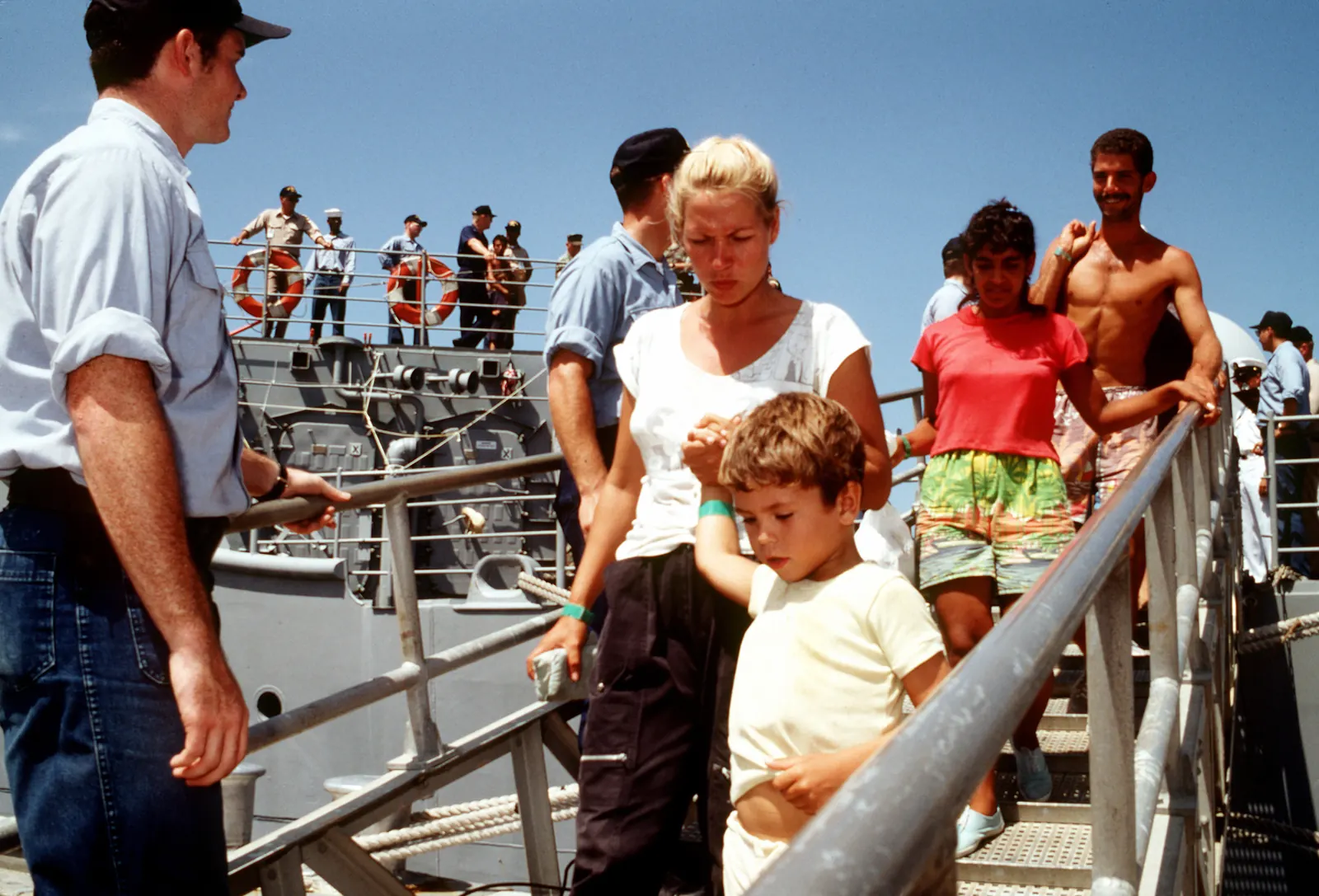

On Friday, August 5, 1994, a rumor ran through Havana that a flotilla of boats was coming from Miami to pick up anyone who wanted to leave. Thousands of people gathered on the Malecón. When police tried to disperse them, the gathering turned into a protest, with shouts of "¡Libertad!" (freedom) and "¡Abajo Fidel!" (down with Fidel), and stones and bottles thrown at the windows of shops and hotels reserved for tourists1. Researchers Holly Ackerman and Juan M. Clark estimated that between 20,000 and 30,000 people took part2. Police detained hundreds and broke up the protest; Fidel Castro then toured the Malecón1. Historian Michael Bustamante summed it up years later for BBC Mundo: "The Maleconazo was the largest protest in the history of the revolution up to that point" (translated from Spanish)3. Over the next six weeks, more than 30,000 Cubans took to the sea, and the United States abandoned the open-door policy it had maintained toward them for three and a half decades14.
Before August 5
The outburst had been building for months. With the economy sunk by the end of the Soviet subsidy, departures by sea rose month after month: the Coast Guard rescued 248 rafters in January 1994 and 1,010 in July2. Between June 4 and August 4 there were seven attempts to hijack ferries and other vessels in Havana Bay1. In June Cuban authorities shot and killed a man trying to escape, and between July 13 and August 8 at least 37 people trying to flee and two Cuban officials died in a series of boat hijackings4. The worst case was the tugboat 13 de Marzo, which sank on July 13 off Havana with 72 people aboard after being rammed by Cuban state vessels; the Inter-American Commission on Human Rights held Cuba responsible for the deaths of 41 of them5.

"We will not stop them from leaving"
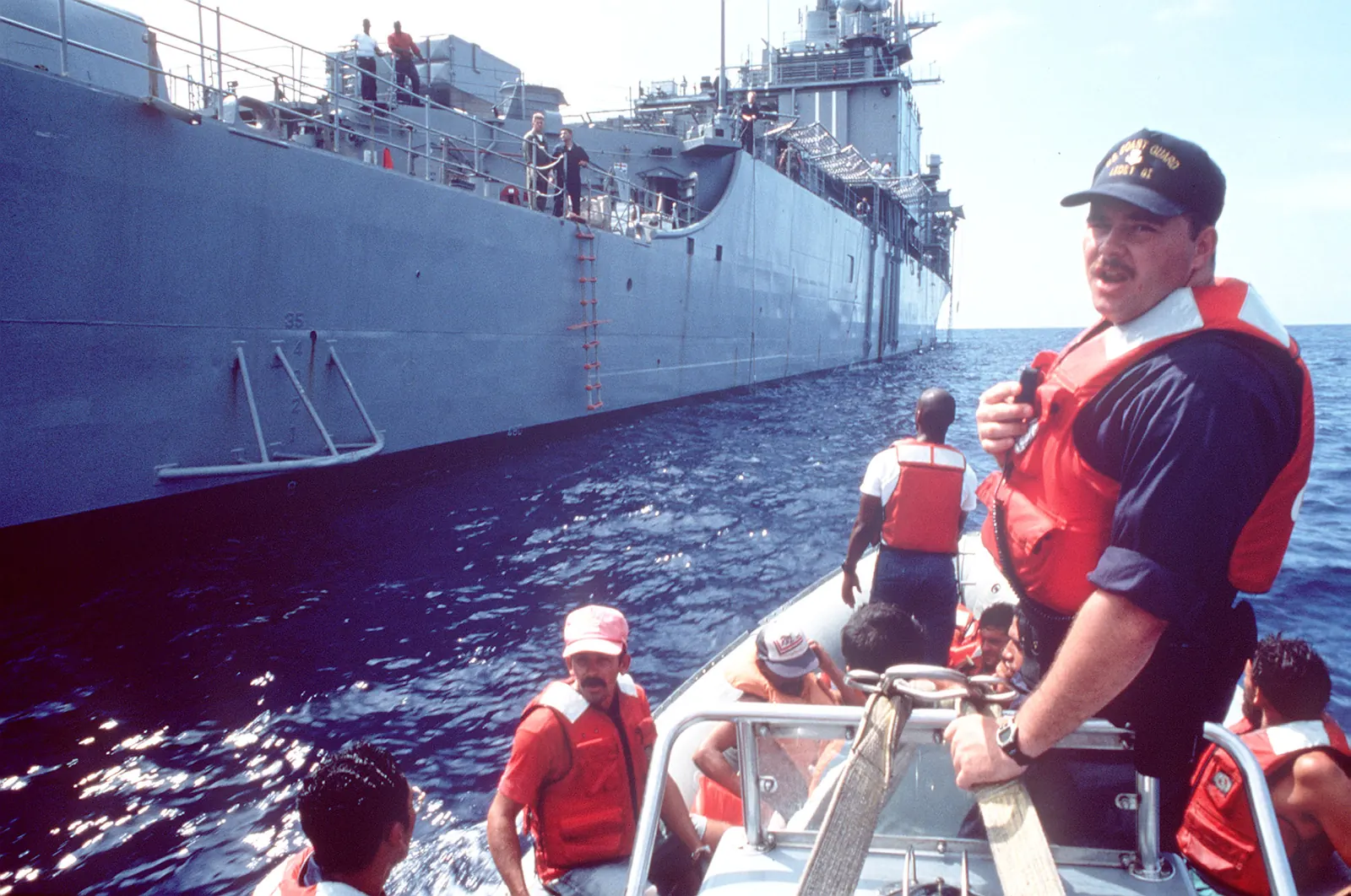
Castro blamed the United States. The day after the protest he warned that if Washington did not take immediate measures to stop encouraging illegal departures, Cuba would be forced to order its coast guard not to intercept any boat leaving the island16. On August 13, in a televised speech, he repeated the threat and demanded the return of the hijackers who had reached Florida4. According to Ackerman and Clark, the government withdrew its coastal surveillance on August 12. The effect shows in Coast Guard numbers: in the first twelve days of August it rescued 729 rafters; in the next twelve, 14,066, almost twenty times as many2.
Thousands of Cubans went to the beaches, built improvised vessels, and put out to sea4. On August 17 more than 500 people a day were leaving, and on August 20 nearly 1,200 tried to cross the straits1. The governor of Florida declared a state of emergency6. Unlike in 1980, the exile community did not organize a flotilla: Clinton thanked Cuban Americans for their "courageous restraint" in not taking their own boats to Cuba7.
August 19: toward Guantánamo
On August 19, Clinton appeared at the White House:
"Today, I have ordered that illegal refugees from Cuba will not be allowed to enter the United States. Refugees rescued at sea will be taken to our naval base at Guantanamo, while we explore the possibility of other safe havens within the region." Bill Clinton, August 19, 19948
He called Castro's conduct a cold-blooded attempt to hold on to power and to export to the United States the crises created in Cuba, and said that several Cubans had already died trying to leave8. Those who reached U.S. soil would be held by the INS while their cases were reviewed1. The next day he announced sanctions: an end to cash remittances to Cuba, family packages limited to medicine, food, and humanitarian items, and charter flights between Miami and Havana reserved for legal immigrants and for travel consistent with the Cuban Democracy Act7. GAO summarized the scope of the decision: it reversed a three-decade policy of welcoming Cubans seeking refuge, and the president and the attorney general indicated at the time that those taken to Guantánamo would have no opportunity to enter the United States afterward4.
The Coast Guard launched Operation Able Vigil, which came to deploy 38 cutters in the Straits of Florida; together with the parallel operation off Haiti, it was the service's largest peacetime operation since the Vietnam War, with more than 63,000 migrants rescued9. The first Cubans reached Guantánamo on August 2210. The base had had Operation Sea Signal under way since May, a joint task force (JTF-160) created to rescue and intercept Haitian rafters, about 15,000 of whom were living there in tents; the operation was expanded to include Cubans and the base prepared to house up to 60,000114.
How many there were
The mass departure lasted about five weeks. Ackerman and Clark count 21,300 rafters rescued in August2. Between August 19 and mid-September the Coast Guard picked up about 32,000, according to Amnesty International, or about 33,000, according to GAO, all taken to Guantánamo64. For 1994 as a whole, which includes those who arrived before Clinton's order, the figures range from about 35,000 rafters, according to the Cuba Platform, to nearly 40,000 Cubans intercepted by the Coast Guard or the Border Patrol, according to the Congressional Research Service (CRS)1213. Ackerman and Clark calculated 45,575 rescued between 1991 and 1994, of whom 16,778 entered the United States directly2.
| Period | Rafters rescued by the Coast Guard |
|---|---|
| 1993 (full year) | 3,656 |
| January 1994 | 248 |
| July 1994 | 1,010 |
| August 1994 | 21,300 |
| September 14-30, 1994 | 80 |
| October 1994 | 20 |
Source: University of Miami Cuban Heritage Collection for 1993; Ackerman and Clark for 199412.
The Joint Communique of September 9
On August 26 the two governments announced they would sit down to negotiate2. On the 28th, Castro ordered his coast guard to prevent unsafe vessels carrying children or teenagers from leaving6. On September 9, after talks in New York, they signed a Joint Communique144. According to Amnesty International's quotation of the text, the United States said it was discontinuing "its practice of granting provisional admission to all Cuban immigrants who arrive in US territory by irregular means" and would continue to take those rescued at sea to facilities outside the country; both governments agreed "to lead Cuban migration through safe, legal and orderly channels"6. Washington would admit at least 20,000 Cubans a year, not counting immediate relatives of U.S. citizens, and in the first year would also provide documents to those already on the visa waiting list136. Cuba, for its part, said it would take effective measures to prevent unsafe departures "using mainly persuasive methods," as Amnesty quotes the communique46. The two countries did not agree on the excludable Cubans and promised to keep talking13.
The U.S. Interests Section calculated that the 20,000 would break down into about 7,000 refugees and relatives, 8,000 visa immigrants and their families, and 5,000 people paroled by lottery, the Special Cuban Migration Program; with the waiting list, the expected total for the first year came to about 26,7004. Clinton said the agreement, if carried out, would replace the massive and dangerous flow with a "safer, legal, and more orderly process"14. Cuba gave 72 hours for unauthorized departures to stop6, and police again patrolled the roads to the beaches with orders to detain anyone carrying rafts or materials to build them4. Between September 14 and 30 the Coast Guard picked up only 80 people2.
Living on a base: Guantánamo and Panama
In September 1994 the Guantánamo camps held about 45,000 people, about 12,000 of them Haitians4. At the beginning of September there were nearly 20,000 Cubans, and their number passed 30,000 before the transfers to Panama. They lived in tents with dirt floors, surrounded by barbed wire, with little drinking water and military rations; in the first months they had no newspapers, television, mail, or telephones10. They wore wristbands with a transponder that recorded their identification number10. About 1,000 preferred to return to Cuba, asking to be repatriated or escaping from the base; some died or were injured crossing the minefields on the Cuban side of the perimeter10. Cuban authorities reported that between September 1 and October 7, some 122 people tried to flee by that route and two died6.
To relieve Guantánamo, the Pentagon moved 8,763 Cubans to camps in Panama beginning in September 19944. The population of the Panamanian camps reached about 8,600 in October. According to GlobalSecurity.org, which summarizes the military operation, the uncertainty turned into disturbances on December 7 and 8, 1994, in which more than 200 U.S. military personnel and 30 Cubans were injured; two migrants drowned in the Panama Canal trying to escape the camps15. From Panama, 1,270 people left on parole for the United States, and in February 1995 the 7,291 who remained were returned to Guantánamo4.
The protocols and the 1995 Joint Statement
The exit from Guantánamo began with the most vulnerable. On October 14, 1994, Clinton announced parole for people over 70, unaccompanied minors, and the seriously ill with their caregivers; on December 2, the attorney general added children and families harmed by a prolonged stay. These were the so-called "four protocols"4. There were more than 3,000 children in the camps, nearly 80 of them unaccompanied16.
In May 1995 more than 21,000 Cubans remained on the base, about 18,000 of them men between 18 and 3017. On May 2 the two governments signed a Joint Statement. The United States could continue to grant humanitarian parole to those at Guantánamo and count up to 5,000 of those entries per year toward the minimum of 20,00018. And from that day the rule at sea changed:
"Effective immediately, Cuban migrants intercepted at sea by the United States and attempting to enter the United States will be taken to Cuba." Joint Statement of the United States and Cuba, May 2, 199518
Those returned would be informed of how to apply for legal admission at the Interests Section in Havana, and the two governments committed that no action would be taken against them for having attempted to emigrate illegally18. Those who managed to set foot on U.S. soil, by contrast, could generally stay and adjust their status a year later under the Cuban Adjustment Act: from that asymmetry came the practice known as wet foot, dry foot13. Cubans at Guantánamo began to leave at a pace of about 500 a week, families with children first174. By June 27, 1995, 14,746 people had entered the United States on parole under the humanitarian protocols4. The last group of rafters from the crisis left the base on January 31, 1996, seventeen and a half months after the first arrived17.
The operation cost the federal government about $497 million between August 1994 and September 1995, $434 million of it to the Department of Defense4.
The human cost
No one knows how many people died in the straits. The University of Miami's Cuban Heritage Collection puts it bluntly: the number of those lost at sea cannot be measured1. During the summer of 1994, with rescues at their peak, Cuban authorities found eight dead within their territorial waters and the Coast Guard two outside them2. To those figures are added the dead of the 13 de Marzo and of the boat hijackings before the crisis54, and those who died in the Guantánamo minefields6.
Long-term estimates are much higher and highly uncertain. Ackerman and Clark report that Cuban and U.S. sources spoke of mortality of up to 75% of those who left, that a computer model of winds and currents indicated that under the best conditions only one in four rafters would reach Florida or be rescued, and that Castro himself stated in 1994 that in the previous four and a half years 51,076 Cubans had tried to leave and 13,275 had succeeded. From these data, they concluded that between 1959 and the end of August 1994 as many as 100,000 rafters might have died, a figure they presented as a maximum and that they themselves found hard to square with the absence of a greater outcry2. As the authors warned, until the Cuban government's records become available, any death toll will be only an estimate2.
Notes and sources
-
University of Miami Libraries, Cuban Heritage Collection, "Crisis & Response: The Rafter Crisis of 1994 and the U.S. Response," digital exhibit Between Despair and Hope: Cuban Rafters at the U.S. Naval Base Guantánamo Bay, 1994-1996, 2011. https://scholar.library.miami.edu/digital/exhibits/show/guantanamo/crisis back back back back back back back back back
-
Holly Ackerman and Juan M. Clark, The Cuban Balseros: Voyage of Uncertainty, Miami, 1995, text deposited in DukeSpace (Duke University). https://hdl.handle.net/10161/12962 back back back back back back back back back back back
-
José Carlos Cueto, "Protestas en Cuba: qué fue el histórico "Maleconazo" de 1994 y cómo se compara con las masivas movilizaciones de este domingo" [Protests in Cuba: what the historic "Maleconazo" of 1994 was and how it compares with this Sunday's mass mobilizations], BBC News Mundo, July 12, 2021. https://www.bbc.com/mundo/noticias-america-latina-57805495 back
-
U.S. General Accounting Office (GAO), "Cuba: U.S. Response to the 1994 Cuban Migration Crisis," GAO/NSIAD-95-211, September 18, 1995, pp. 2-4, 8-13. https://www.gao.gov/products/nsiad-95-211 back back back back back back back back back back back back back back back back back back back
-
Inter-American Commission on Human Rights, Report No. 47/96, Case 11.436, "Victims of the Tugboat "13 de Marzo" v. Cuba," October 16, 1996 (University of Minnesota Human Rights Library). http://hrlibrary.umn.edu/cases/1996/cuba47-96.htm back back
-
Amnesty International, "United States/Cuba: Cuban "Rafters", Pawns of Two Governments," AMR 51/86/94, October 1994. https://www.amnesty.org/en/wp-content/uploads/2021/06/amr510861994en.pdf back back back back back back back back back back
-
Bill Clinton, "Statement on Cuba," August 20, 1994, in The American Presidency Project (UC Santa Barbara). https://www.presidency.ucsb.edu/documents/statement-cuba-0 back back
-
Bill Clinton, "The President's News Conference," August 19, 1994, in The American Presidency Project. https://www.presidency.ucsb.edu/documents/the-presidents-news-conference-1232 back back
-
U.S. Coast Guard, Office of Law Enforcement, "Alien Migrant Interdiction" (copy archived in 2008 by the University of North Texas). https://webarchive.library.unt.edu/eot2008/20081103212952/http://www.uscg.mil/hq/cg5/cg531/amio.asp back
-
University of Miami Libraries, Cuban Heritage Collection, "Life at the Guantánamo Camps: Detention," digital exhibit Between Despair and Hope, 2011. https://scholar.library.miami.edu/digital/exhibits/show/guantanamo/detention back back back back
-
University of Miami Libraries, Cuban Heritage Collection, "Guantánamo: A New Challenge for the United States' Oldest Military Base Overseas," digital exhibit Between Despair and Hope, 2011. https://scholar.library.miami.edu/digital/exhibits/show/guantanamo/guantanamo back
-
The Cuba Platform, "The Special Period," accessed November 11, 2026. https://cubaplatform.org/special-period back
-
Ruth Ellen Wasem, "Cuban Migration to the United States: Policy and Trends," Congressional Research Service, R40566, June 2, 2009, pp. 1-3. https://www.everycrsreport.com/reports/R40566.html back back back back
-
Bill Clinton, "Statement on the Cuba-United States Agreement on Migration," September 9, 1994, in The American Presidency Project. https://www.presidency.ucsb.edu/documents/statement-the-cuba-united-states-agreement-migration back back
-
GlobalSecurity.org, "Operation Safe Haven / Safe Passage," accessed November 11, 2026. https://www.globalsecurity.org/military/ops/safe_haven.htm back
-
University of Miami Libraries, Cuban Heritage Collection, "Life at the Guantánamo Camps: Uncertainty," digital exhibit Between Despair and Hope, 2011. https://scholar.library.miami.edu/digital/exhibits/show/guantanamo/uncertainty back
-
University of Miami Libraries, Cuban Heritage Collection, "The Last Detainees," digital exhibit Between Despair and Hope, 2011. https://scholar.library.miami.edu/digital/exhibits/show/guantanamo/last back back back
-
United States and Cuba, "Joint Statement With the Republic of Cuba on Normalization of Migration," May 2, 1995, in The American Presidency Project. https://www.presidency.ucsb.edu/documents/joint-statement-with-the-republic-cuba-normalization-migration back back back