2017-2020
The End of "Wet Foot, Dry Foot"
The Adjustment Act stands, but the door at the border closes

On Thursday, January 12, 2017, eight days before leaving the White House, Barack Obama ended the policy that for more than two decades had allowed Cubans who managed to set foot on U.S. soil to stay:
"Effective immediately, Cuban nationals who attempt to enter the United States illegally and do not qualify for humanitarian relief will be subject to removal, consistent with U.S. law and enforcement priorities. By taking this step, we are treating Cuban migrants the same way we treat migrants from other countries." Barack Obama, statement on Cuban immigration policy, January 12, 20171
The same day, in Havana, the two governments signed a Joint Statement, in English and Spanish, that took effect immediately. The United States ended the "special parole policy for Cuban nationals who reach the territory of the United States (commonly referred to as the wet foot-dry foot policy)," as well as the parole program for Cuban health care professionals in third countries2. The history of that policy is told in Wet Foot, Dry Foot.
What was signed in Havana
The Joint Statement had six points. From the date of signing, the United States would return and Cuba would receive back all Cubans who, after that date, were found trying to enter or stay irregularly in violation of U.S. law. Cuba would study case by case the return of those already in that situation before the signing, and accepted that the list of 2,746 people awaiting return since the Mariel exodus could be completed with others who had left through that port in 1980. Both countries committed to apply their migration and asylum laws without selective criteria and to cooperate against human trafficking. The United States, for its part, would continue to guarantee legal migration from Cuba of at least 20,000 people a year. The 1984, 1994 and 1995 accords remained in force in everything not modified, including the return of those intercepted at sea2.
The Department of Homeland Security (DHS) explained the changes in a statement and a fact sheet. It rescinded the policy of the former Immigration and Naturalization Service (INS) that encouraged granting parole to Cubans who arrived, so that they could take advantage of the Adjustment Act; from that day on, parole requests from Cubans would be considered the same as those from any other nationality34. The doctors' program, the Cuban Medical Professional Parole (CMPP), stopped accepting applications at 5:00 p.m. Eastern time on January 125. And the exception that kept expedited removal (deportation without a hearing before a judge) from being applied to Cubans disappeared. The notice published in the Federal Register made it applicable to Cubans encountered from January 13, without the usual period for public comment because, according to DHS, announcing it in advance could provoke a surge of Cubans trying to enter before the change took effect6.
The White House justified ending the doctors' program with a foreign policy argument: the two countries were working together against disease, and giving preferential treatment to Cuban health personnel contradicted that cooperation and risked harming the Cuban people. From then on, those professionals could apply for asylum like any other foreign national1.
Reactions and people in transit
The Cuban government welcomed the decision as "an important step in the advancement of bilateral relations" and maintained that the earlier policy had been "a stimulus to irregular emigration, to migrant smuggling and to irregular entries into the United States" (translated from Spanish)7. It said the doctors' program had been "a virtual international brain-theft operation" (translated from Spanish)7. It also called for repeal of the Adjustment Act, something only Congress can do8. In Miami, Mayor Tomás Regalado called the announcement "Obama's farewell gift to Raúl Castro" (translated from Spanish), while the Cuban American National Foundation said the policy had never been a fair alternative and that "fleeing is not and never will be the answer" (translated from Spanish)7.
The change, effective immediately, caught those already on the road. In fiscal year 2017, 20,955 Cubans entered the United States without a visa, almost 18,000 of them before January 129. A month later, NBC News reported on Cuban doctors who had left their missions and were in Colombia, unable to return to Cuba and at risk of deportation if they stayed; according to one of them, about 500 Cubans were waiting there for their visas10. In Panama, the 55 Cuban migrants still at a temporary shelter in Gualaca, in Chiriquí province, returned to the island in early November 2017, in a voluntary repatriation process begun in August1112.
What did not change
The Adjustment Act was not touched. The DHS statement itself said so: "Though the Cuban Adjustment Act and certain Cuban laws remain in effect," the announcement went a long way toward putting the relationship with Cuba on equal terms with those of other neighbors3. The law continued to require the same things: that the Cuban have been inspected and admitted or paroled, and have been in the country at least one year4. As the Congressional Research Service (CRS) noted in 2025, it is an adjustment law that is not limited to a closed group of people and has no expiration date13. Since 1996, its repeal has been tied to the clause requiring a democratically elected government in Cuba, as explained in the previous chapter.
What disappeared was the nearly automatic path to meeting those requirements. Someone who entered with a visa and was admitted, or received parole under the general rules, could still adjust status after a year if he met the other requirements4. The family reunification program (CFRP) remained in effect, and so did the commitment to 20,000 travel documents a year42. According to a Wilson Center study, between 2017 and 2019 many Cubans who entered to seek asylum were able to stay while their cases moved forward and, on reaching one year in the country, applied for residence under the Adjustment Act even though the asylum process had not ended14. The legal consequences of the different ways of leaving custody at the border are covered in Parole and I-220A.
Trump in Miami
On June 16, 2017, at the Manuel Artime Theater in Miami, President Donald Trump announced his policy toward Cuba. "Effective immediately, I am canceling the last administration's completely one-sided deal with Cuba," he said, and called it a "terrible and misguided deal"15. There he signed a National Security Presidential Memorandum (NSPM-5). Its main changes were to restrict transactions with companies controlled by the Cuban military and the intelligence and security services and to eliminate individual "people-to-people" educational travel; most of Obama's opening, including diplomatic relations, stayed in place9. On migration, the memorandum confirmed what had been decided in January: executive policy would be to "[n]ot reinstate" the "Wet Foot, Dry Foot" policy, which, according to the text, "encouraged untold thousands of Cuban nationals to risk their lives to travel unlawfully to the United States"16.
The empty embassy
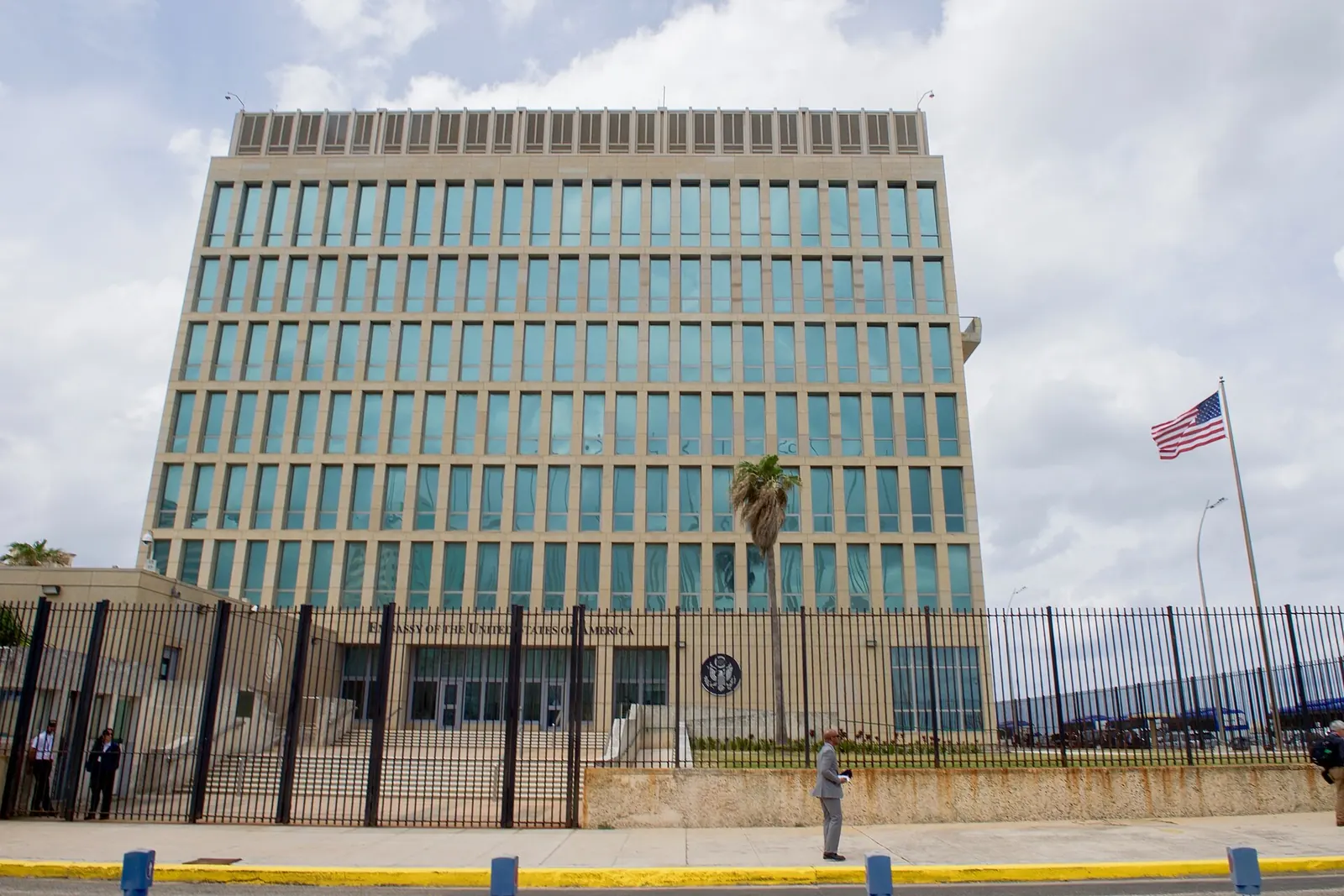
On September 29, 2017, Secretary of State Rex Tillerson reported that 21 employees of the embassy in Havana had suffered injuries from "attacks of an unknown nature," with symptoms including ear complaints, hearing loss, dizziness, headaches, fatigue, cognitive problems and sleep disturbances. That day, the State Department ordered nonessential staff and all family members to leave, and advised Americans not to travel to Cuba17. The U.S. embassy staff, which had numbered more than 50, was cut by about two thirds. On October 3, Washington ordered 15 Cuban diplomats out of their embassy in Washington, and by June 2018 the number of recognized victims had reached 269.
The cause was never established in that period. The press spoke of "sonic attacks," but several scientists doubted that an acoustic device could cause such damage. A study published in JAMA in February 2018 described injuries to brain networks without finding the cause, and a University of Michigan report suggested that the recorded sounds might be due to two listening devices placed close to each other. The Cuban government denied any responsibility, and its foreign minister maintained that, according to Havana's preliminary conclusions, there was no evidence that the incidents had occurred9.
For Cubans, the practical consequence was a freeze on paperwork. The embassy suspended almost all visa issuance. Visitor visas had to be requested in another country, and immigrant visas moved first to the embassy in Bogotá18 and, from April 1, 2018, to the one in Georgetown, Guyana19. Between October 2017 and January 2018, the embassy issued 29 immigrant visas, compared with 9,752 in all of fiscal year 201720. U.S. Citizenship and Immigration Services (USCIS) suspended its Havana office in 2017 and closed it permanently on December 10, 201821. With the staff reduction and that closure, the CFRP was suspended13; in earlier years about 75% of the travel documents for Cuban immigrants had been issued through it21. In early 2019, some 22,000 beneficiaries with conditionally approved family parole were waiting in Cuba for the next stage of the process, according to the Miami Herald22. The United States met the commitment of 20,000 documents in fiscal year 20179, but not in 2018 or 2019, and by the end of June 2020 it had issued 2,866 in that fiscal year21. The embassy's refugee section also closed9.
A three-month visa
On March 15, 2019, the embassy announced that, starting March 18, the B-2 visa (for tourism, family visits or medical treatment) for Cubans would be valid for three months and a single entry. Until then it had been granted for 60 months, with multiple entries, for $160. The official reason was reciprocity: Cuba gave American tourists a single entry for a stay of two months, extendable by 30 days, for $50. Five-year visas already issued remained valid until they expired23. According to CRS, the measure made family visits harder, as well as trips by self-employed Cubans who brought supplies for their businesses from the United States21.
Waiting in Mexico
Without the special path, Cubans kept coming to the southern border, but now to seek asylum like any other migrant. The immigration courts opened 24,198 removal cases against Cubans in fiscal year 2019, compared with 388 in the year before the end of wet foot, dry foot14. Cubans without a visa who presented themselves at southwest border ports of entry rose from 7,079 in fiscal year 2018 to 21,499 in 2019, and the Border Patrol detained 11,645, compared with only 74 the year before2114.
Two policies left them on the Mexican side. The first was the limit on the number of asylum seekers each port processed per day (metering), which produced waiting lists in border cities. In the spring of 2019, nearly all of the 4,500 names on the list in Ciudad Juárez, across from El Paso, were Cubans, according to an Associated Press tally14. The second was the Migrant Protection Protocols (MPP), known as "Remain in Mexico," which required people to wait in Mexico for their U.S. court hearings. They began in January 2019 in San Diego and were extended along the entire border after Mexico agreed to the expansion in June, under the threat of tariffs. Through January 2020, 7,919 Cubans had been sent to wait in Mexico, 13% of all people subject to the program and the third-largest nationality after Hondurans and Guatemalans. Of 3,041 court decisions on Cubans in the program through May 2020, 267 were favorable to the applicants14.
Outside those protocols, Cubans fared better than other nationalities before the judges: in fiscal year 2019, 753 of 1,562 were granted asylum, or 47.1%, when the overall rate was 29.4%14. Deportations to Cuba also grew. Immigration and Customs Enforcement (ICE) deported 1,179 Cubans in fiscal year 2019, compared with 463 in 2018, and some 41,000 Cubans in the United States had final orders of removal21. The Wilson Center, relying on the Associated Press and using a different measure, estimated that Cuba had accepted about 800 deportees in fiscal year 201914.
Title 42
On March 20, 2020, with the COVID-19 pandemic, the Centers for Disease Control and Prevention (CDC) issued an order under sections 362 and 365 of the Public Health Service Act, codified in Title 42 of the U.S. Code, suspending the entry of certain persons across land borders24. The order allowed rapid expulsions outside the ordinary immigration procedure and in practice halted asylum applications14. In fiscal year 2020, U.S. Customs and Border Protection (CBP) recorded 14,015 encounters with Cubans, 4,751 of them expulsions under Title 42; in April 2020 there were only 18325.
Four years in numbers
| Fiscal year | Intercepted by the Coast Guard | Cubans without a visa at the border |
|---|---|---|
| 2016 | 5,230 | 58,270 at ports of entry and between ports |
| 2017 | 2,109 | 20,955 at ports of entry and between ports |
| 2018 | more than 300 | 7,355 at ports of entry and between ports |
| 2019 | no figure in the sources consulted | 21,499 at southwest ports and 11,645 detained by the Border Patrol |
| 2020 | no figure in the sources consulted | 14,015 CBP encounters, 4,751 of them expulsions |
Sources: Coast Guard, CBP and State Department, compiled by CRS921; Wilson Center14; CBP25. The 2019 and 2020 series measure different things and are not comparable with each other.
At sea, the change was felt immediately. The Coast Guard intercepted 2,109 Cubans in fiscal year 2017, most of them before January 12, and only 134 between October 2017 and July 11, 20189. When this period ended, Cubans who wanted to emigrate depended on a distant consulate, a three-month visa or an asylum application made from Mexico. What came next is told in The Great Exodus.
Notes and sources
-
White House, "Statement by the President on Cuban Immigration Policy," January 12, 2017. https://obamawhitehouse.archives.gov/the-press-office/2017/01/12/statement-president-cuban-immigration-policy back back
-
Department of State, "Migration and Refugees: Joint Statement Between the United States of America and Cuba, Signed at Havana January 12, 2017," Treaties and Other International Acts Series 17-112, texts in English and Spanish. https://www.govinfo.gov/content/pkg/GOVPUB-S-PURL-gpo78151/pdf/GOVPUB-S-PURL-gpo78151.pdf back back back
-
Department of Homeland Security (DHS), "Statement by Secretary Johnson on the Continued Normalization of our Migration Relationship with Cuba," January 12, 2017 (archived copy). https://web.archive.org/web/20171017191611/https://www.dhs.gov/news/2017/01/12/statement-secretary-johnson-continued-normalization-our-migration-relationship-cuba back back
-
DHS, "Fact Sheet: Changes to Parole and Expedited Removal Policies Affecting Cuban Nationals," January 12, 2017 (archived copy). https://web.archive.org/web/20171019175128/https://www.dhs.gov/sites/default/files/publications/DHS%20Fact%20Sheet%20FINAL.pdf back back back back
-
USCIS, "Cuban Medical Professional Parole (CMPP) Program," accessed November 11, 2026. https://www.uscis.gov/humanitarian/humanitarian-parole/cuban-medical-professional-parole-cmpp-program back
-
DHS, "Eliminating Exception To Expedited Removal Authority for Cuban Nationals Encountered in the United States or Arriving by Sea," Federal Register, vol. 82, pp. 4902-4905, January 17, 2017. https://www.federalregister.gov/documents/2017/01/17/2017-00914/eliminating-exception-to-expedited-removal-authority-for-cuban-nationals-encountered-in-the-united back
-
BBC Mundo, "Qué ganan y pierden Cuba y Estados Unidos con la decisión de Obama de acabar con la política de "pies secos, pies mojados"" [What Cuba and the United States gain and lose from Obama's decision to end the "wet foot, dry foot" policy], January 13, 2017. https://www.bbc.com/mundo/noticias-america-latina-38604691 back back back
-
Silvia Ayuso, "Obama pone fin a la política de “pies secos, pies mojados” para los cubanos" [Obama ends the "wet foot, dry foot" policy for Cubans], El País, January 13, 2017. https://elpais.com/internacional/2017/01/12/estados_unidos/1484257647_081706.html back
-
Mark P. Sullivan, "Cuba: U.S. Policy in the 115th Congress," Congressional Research Service (CRS), report R44822, updated September 1, 2018, pp. 32-41 and 58-61. https://www.congress.gov/crs_external_products/R/PDF/R44822/R44822.20.pdf back back back back back back back back
-
Carmen Sesin, "Cuban Doctors Stranded: Can't Travel to US, Cuba, or Stay in Colombia," NBC News, February 20, 2017. https://www.nbcnews.com/news/latino/cuban-doctors-stranded-can-t-travel-us-cuba-or-stay-n720491 back
-
José Vásquez, "Inicia traslado de cubanos del albergue de Gualaca a la Isla de Cuba" [Transfer of Cubans from the Gualaca shelter to the island of Cuba begins], Panamá América, October 23, 2017. https://www.panamaamerica.com.pa/provincias/inicia-traslado-de-cubanos-del-albergue-de-gualaca-la-isla-de-cuba-1086828 back
-
Telemetro, "Concluye repatriación voluntaria de migrantes cubanos albergados en Chiriquí" [Voluntary repatriation of Cuban migrants sheltered in Chiriquí concludes], November 2, 2017. https://www.telemetro.com/nacionales/Concluye-repatriacion-voluntaria-albergados-Chiriqui_0_1077792510.html back
-
Andorra Bruno, "Immigration Parole," CRS, report R46570, updated September 18, 2025. https://www.congress.gov/crs_external_products/R/PDF/R46570/R46570.4.pdf back back
-
Guadalupe Correa-Cabrera and Elliot Spagat, "U.S. Immigration Policy for Cubans: From Revolution to COVID-19," Wilson Center, Latin American Program, October 2020, pp. 5-15. https://www.wilsoncenter.org/sites/default/files/media/uploads/documents/FINAL%20U.S.%20IMMIGRATION%20POLICY%20FOR%20CUBANS-%20FROM%20REVOLUTION%20TO%20COVID-19_0.pdf back back back back back back back back back
-
White House, "Remarks by President Trump on the Policy of the United States Towards Cuba," Manuel Artime Theater, Miami, June 16, 2017. https://trumpwhitehouse.archives.gov/briefings-statements/remarks-president-trump-policy-united-states-towards-cuba/ back
-
"Strengthening the Policy of the United States Toward Cuba," National Security Presidential Memorandum NSPM-5 of June 16, 2017, Federal Register, vol. 82, pp. 48875-48878, October 20, 2017, section 2(e). https://www.federalregister.gov/documents/2017/10/20/2017-22928/strengthening-the-policy-of-the-united-states-toward-cuba back
-
Rex W. Tillerson, Secretary of State, "Actions Taken in Response to Attacks on U.S. Government Personnel in Cuba," September 29, 2017 (archived copy). https://web.archive.org/web/20210426025141/https://2017-2021.state.gov/actions-taken-in-response-to-attacks-on-u-s-government-personnel-in-cuba/index.html back
-
Mark P. Sullivan, "Cuba: U.S. Policy in the 115th Congress," CRS, report R44822, November 22, 2017 version. https://www.everycrsreport.com/files/20171122_R44822_513de2af64f59c46db87b7893349e9901bbe17c6.pdf back
-
Mark P. Sullivan, "Cuba: U.S. Policy in the 115th Congress," CRS, report R44822, May 11, 2018 version. https://www.everycrsreport.com/files/20180511_R44822_8dee1f66a2791fd689d2a62cc5e7e19fde6b7501.pdf back
-
Mark P. Sullivan, "Cuba: U.S. Policy in the 115th Congress," CRS, report R44822, February 27, 2018 version. https://www.everycrsreport.com/files/20180227_R44822_a808cb6ee5632e32c2211d89f5b63c95552dcbbc.pdf back
-
Mark P. Sullivan, "Cuba: U.S. Policy in the 116th Congress and Through the Trump Administration," CRS, report R45657, updated January 22, 2021, pp. 50-54. https://www.everycrsreport.com/files/2021-01-22_R45657_fad0487b6ec228d765afe4efa0a73ca16f17a02c.pdf back back back back back back back
-
Cuba Study Group, "Trump's immigration policies keep more than 20,000 Cubans in limbo," January 6, 2019, summary of a Miami Herald article. https://cubastudygroup.org/csg_resources/trumps-immigration-policies-keep-more-than-20000-cubans-in-limbo back
-
U.S. Embassy in Havana, "Decreasing B2 Visa Validity for Cuban Nationals," press release, March 15, 2019 (archived copy). https://web.archive.org/web/20191122232334/https://cu.usembassy.gov/decreasing-b2-visa-validity-for-cuban-nationals/ back
-
Centers for Disease Control and Prevention (CDC), "Notice of Order Under Sections 362 and 365 of the Public Health Service Act Suspending Introduction of Certain Persons From Countries Where a Communicable Disease Exists," Federal Register, vol. 85, p. 17060, March 26, 2020 (order issued and in effect since March 20, 2020). https://www.federalregister.gov/documents/2020/03/26/2020-06327/notice-of-order-under-sections-362-and-365-of-the-public-health-service-act-suspending-introduction back
-
U.S. Customs and Border Protection, "Nationwide Encounters," dataset for fiscal years 2020 to 2022 (file of July 16, 2022), rows with nationality CUBA for fiscal year 2020, own calculation. https://web.archive.org/web/20220716154450/https://www.cbp.gov/sites/default/files/assets/documents/2022-Jul/nationwide-encounters-fy20-fy22-jun.csv back back