1960-1962
Operation Pedro Pan
More than 14,000 boys and girls who flew to Miami alone
At 4:30 in the afternoon on December 26, 1960, Pan American World Airways flight 422 from Havana landed at Miami International Airport.1 On board were the first minors of a program no one had planned on that scale. Through October 1962, more than 14,000 Cuban girls, boys and teenagers would arrive alone in the United States, sent by parents who stayed on the island and expected a short separation.23 It was, according to the association that now brings those minors together, the largest recorded exodus of unaccompanied minors in the Western Hemisphere.2
A boy named Pedro
Bryan O. Walsh was born in Ireland in 1930, was ordained a priest in 1954, and since 1958 had directed the Catholic Welfare Bureau, the Catholic charities office of the Diocese of Miami.2 In the fall of 1960 that small agency, licensed to care for and place children for adoption, was looking after about 80 children.3 Walsh would recall that it all began when a Cuban came into his office with a fifteen-year-old boy, Pedro, whom his parents had sent to Miami with relatives because they feared the changes in Cuba. The relatives, recent refugees, could not support him.4 Walsh then understood, according to the story kept by the association of former Pedro Pans, that "there would be many more 'Pedros.'"2 In a 1971 academic article he placed the moment his agency became aware of the problem in mid-November 1960.1
He was not the only case. A 1967 report by the Department of Health, Education, and Welfare (HEW) tells how in November 1960 a mother brought her two children to Key West and asked the juvenile court judge to find them a home: she feared they would be sent to Russia because she and her husband were actively opposed to the government. Then she went back to Cuba. In Miami, homeless Cuban teenagers were beginning to appear.3 Walsh took the matter to the Dade County Welfare Planning Council, which set up a committee to work with Tracy Voorhees, Eisenhower's envoy. Voorhees recommended that the federal government finance the care of unaccompanied minors.32
James Baker and the Ruston Academy
At the same time, in Havana, James Baker, head of the Ruston Academy, an American school, was organizing with members of the American Chamber of Commerce a network to get out of the country the children of Cuban families who had no one to receive them in the United States.32 On December 12, 1960, Baker and Walsh met and divided the work: Baker would get the children out of Cuba and Walsh would give them refuge.2
The initial plan was for them to travel on student visas. Because of delays, only 25 had been issued when the United States broke relations with Cuba on January 3, 1961; the first children arrived earlier, from December 26, on tourist visas.3 Walsh said in 1998 that a State Department official called him days before Christmas to ask him to take responsibility for about 200 minors, because "there is a great fear in Cuba" that on January 1 the authority of parents would be taken away.4
The visa waivers
When relations were broken, Baker and his team already had 510 children waiting for a place. Baker returned to the United States on January 4 and, with Walsh, negotiated with the State Department and the Immigration and Naturalization Service (INS) for the minors to enter without visas. Within days 225 visa waivers were authorized, with a commitment to grant more; when the federal government took over the program, they were being granted in blocks of 500.3
According to Walsh, the State Department allowed him to extend the waiver to any minor between six and sixteen without sending the name in advance; for those from sixteen to eighteen it required the list beforehand, with dates of birth, to run a security check. As a contingency plan, a route through Jamaica was opened, where the Church in Kingston housed the children before they continued on their way.45 Inside Cuba a network of volunteers operated in which, according to Operation Pedro Pan Group, Briton Penny Powers and the brothers Ramón and Polita Grau played a central role. Exiles in Miami requested thousands of waivers for their relatives and sent them to Cuba along with a $25 money order for the round-trip fare.2 The association insists that the Cuban Catholic Church, as an institution, never took part, although some priests and members of religious orders requested and received waivers.2
The rumor about parental authority
Why did parents send their children off alone? The sources repeat several reasons. Operation Pedro Pan Group sums them up as fear of Communist indoctrination, of losing parental authority (patria potestad), and, from June 1961, of the closing of Catholic and private schools.2 Two brothers, twelve and ten, who arrived in Evansville, Indiana, in March 1962 told a reporter that their parents got them out because they had not set foot in a school since Castro closed them, because they were hungry, and because they were afraid "the Communists might send them to Russia."6
The rumor that the state was going to take parental authority away from parents circulated from late 1960. Walsh recalled that it was expected for January 1, 1961, and that Castro's speech of those days said nothing about it: "That was a false alarm."4 In December 1961, before a Senate subcommittee, a leader of a Miami organization spoke of laws in preparation to keep children over five from leaving Cuba and gave a new deadline of January 1, 1962.7
The origin of the rumor remains disputed. The official Cuban version, found in the state encyclopedia EcuRed and in the book Operación Peter Pan: un caso de guerra psicológica contra Cuba [Operation Peter Pan: A Case of Psychological Warfare Against Cuba] (2000), by Ramón Torreira Crespo and José Buajasan Marawi, holds that the whole operation was a subversion maneuver organized by the State Department, the CIA, the Miami Catholic hierarchy and exile groups, and that the CIA fabricated the rumor: that Radio Swan broadcast from October 26, 1960 messages such as "Cuban mother, listen to this! The government's next law will be to take your children from you from age five to age 18" (translated from Spanish), and that a false "patria potestad law" was drafted in the United States and distributed clandestinely on the island.8 Declassified U.S. documents confirm that Radio Swan was a clandestine station installed by the CIA on Swan Island, ready to broadcast from May 17, 1960.9 What those documents do not establish is who authored the rumor.
One of those girls, political scientist María de los Ángeles Torres, a professor at DePaul University, sued the CIA in 1998 under the Freedom of Information Act to obtain its files on the operation. The agency maintained that its searches had turned up no relevant documents; according to the court, it later handed over only a couple of pages of no real value. On March 12, 1999, a federal judge in Chicago dismissed the suit, without costs to the plaintiff, and added that the tone and content of the roughly 800 pages he had reviewed privately supported the agency's denial that it had taken part directly in the children's program.10 The ruling did not address the rumor.
The camps
Walsh improvised with what he had on hand. For the first arrivals he used a house on Brickell Avenue and bunks taken from Camp Matecumbe, a summer youth camp.4 Dade County lent him a building in Kendall that had been built for Black children in the days of segregation and had been left empty.4 According to a 1988 Reader's Digest report, the diocese provided a 150-acre camp 18 miles south of the city, Walsh leased an apartment block in Florida City, where he fenced off the streets so the children could play safely, and the federal government lent renovated World War II barracks northwest of Miami.5 Operation Pedro Pan Group lists Kendall, Florida City and Matecumbe as the main camps,11 and among the photographs in Walsh's archive is one of him with Cuban boys at St. Raphael's Hall.12
They were places of passage. In March 1962 a reporter counted four "transit camps" in the county; most children left for the north after a week or so.6 "Never in our wildest dreams did we think we'd have 8,000 children in our care," Walsh recalled in 1978.13
A federal program in forty states
On February 3, 1961, Kennedy included among his nine measures for Cuban refugees "financial aid for the care and protection of unaccompanied children, the most defenseless and troubled group among the refugee population."14 On February 21 the Florida Department of Public Welfare signed an agreement with HEW and, from March 1, contracted as federal agent with four agencies: the Catholic Welfare Bureau, the Dade County Children's Service Bureau (for Protestant children), the Jewish Family and Children's Service, and the Jewish service United HIAS, based in New York. The government paid $6.50 a day for each minor in a center and $5.50 for each in a foster family.3
Legal custody remained with the parents, who were in Cuba. Since the separation was expected to be brief, no minor was placed for adoption.32 As of April 30, 1967, at least 137 agencies in 110 cities in 40 states, the District of Columbia and Puerto Rico had taken part in the program;3 Operation Pedro Pan Group speaks of more than 100 cities in 35 states and mentions homes for teenagers run by Cuban foster parents in Wilmington (Delaware), Fort Wayne (Indiana), Albuquerque (New Mexico), Lincoln (Nebraska), Jacksonville and Orlando.2 A March 1962 news story describes the arrival in Evansville of five children between ten and thirteen, on their way to a children's home in Vincennes, Indiana, that already housed 34 Cubans.6
The profiles were similar. According to HEW, most were in the early years of adolescence and almost two thirds were boys.3 Operation Pedro Pan Group estimates that half were reunited with relatives or friends at the airport itself and that, of the roughly 7,000 who stayed in the care of the Catholic Welfare Bureau, 85 percent were between 12 and 18.2
Pedro Pan, by that name
The operation was kept quiet for more than a year, with the cooperation of the Miami journalists who knew the story.5 In March 1962 reporter Gene Miller published it in the Miami Herald and other papers, and gave it a name.156 His story read:
"At 17,000 feet a frightened 11-year-old Cuban girl clings to a Raggedy Ann doll. [...] This is the underground railway in the sky [...] Operation Peter Pan. Maybe it should be called Operation Pedro Pan." Gene Miller, The Evansville Press, March 10, 19626
According to that report, in fifteen months the Diocese of Miami had quietly helped 7,778 minors, and nearly 3,000 had already flown north.6
October 1962
The children kept coming until the October Crisis cut the commercial flights. That month the peak was reached: 4,100 minors in care.3 The airlift ended with the crisis, on October 22, 1962; the same association places the last arrivals on the 23rd in another text.2 The most-cited total, 14,048, is the one given by Operation Pedro Pan Group and the Institute for Cuban Studies at Florida International University (FIU).216 HEW, which did not keep count of those who never passed through an agency, estimated in 1967 that between 13,000 and 15,000 had arrived.3 Through April 30 of that year the federal government had paid for the care of 8,331 minors, 7,041 of them through the Catholic Welfare Bureau, at a total cost of $28.5 million.3
The wait and the reunion
With the flights cut, parents were left only with the routes through Mexico and Spain, where they had to wait for a visa with no money and no permission to work. In 1964 the Cuban Refugee Program agreed with the Departments of State and Justice on a system to bring parents of unaccompanied minors from those countries with priority.3 Those years are told in the closed-door years.
The solution came with the airlift that began on December 1, 1965 between Varadero and Miami, in which parents of these children had priority.32 Through April 30, 1967, the parents, or one parent, of 2,436 minors arrived by that route, and the number of children in foster care fell from 1,448 at the end of 1965 to 375.3 Operation Pedro Pan Group states that about 90 percent of those still in care were reunited with their parents before June 1966.2 There were delays: the Cuban government did not let young people from 15 to 26, of military age, leave, and held back certain professionals.23 And there were permanent absences: in 1967 HEW counted more than 300 minors whose parents, "from all indications, may never leave Cuba."3 The association of former Pedro Pans maintains that there is no record of a single lost child;2 the official Cuban version claims that many never saw their parents again.8 The families' return on the flights is told in Camarioca and the Freedom Flights.
The voices
Published testimonies agree on a mix of fear and adventure. "I cried just a little," one of the boys told Gene Miller in 1962; "Mother cried mucho."6 A mother wrote from Cuba to a U.S. institution to ask for an explanation, because her daughter complained that "here they feed us only spinaches."3 Carlos Mayans, who arrived at thirteen in April 1962 and decades later became mayor of Wichita, Kansas, recalled the telegram a messenger on a bicycle delivered to him: he was to report at six the next morning at the Havana airport, with two changes of clothes and a pair of shoes, without being able to say goodbye to his father, who worked at a sugar mill in Santiago de Cuba.2
Where the records are
The individual files of the minors served by the Church are held by Catholic Charities of the Archdiocese of Miami, which allows only the individuals themselves to consult them, in the presence of its staff.2 Barry University, in Miami Shores, holds the papers of Monsignor Walsh, who was buried on Christmas Eve 2001: 72 boxes from 1948 to 2001, with a section devoted to Operation Pedro Pan and the Cuban Children's Program and oral history interviews from 1994 and 1998.12 The Cuban Heritage Collection at the University of Miami holds the records of the Cuban Refugee Center, with a subseries on the unaccompanied minors program.17 Operation Pedro Pan Group, which runs a museum on the seventh floor of the Freedom Tower, has digitized and posted on its site articles, reports and testimonies from the period.215
Notes and sources
-
Bryan O. Walsh, "Cuban Refugee Children," Journal of Interamerican Studies and World Affairs, vol. 13, no. 3-4, October 1971, pp. 378-415 (opening abstract). https://doi.org/10.2307/174929 back back
-
Operation Pedro Pan Group, "History," accessed November 11, 2026. https://www.pedropan.org/history back back back back back back back back back back back back back back back back back back back back back back
-
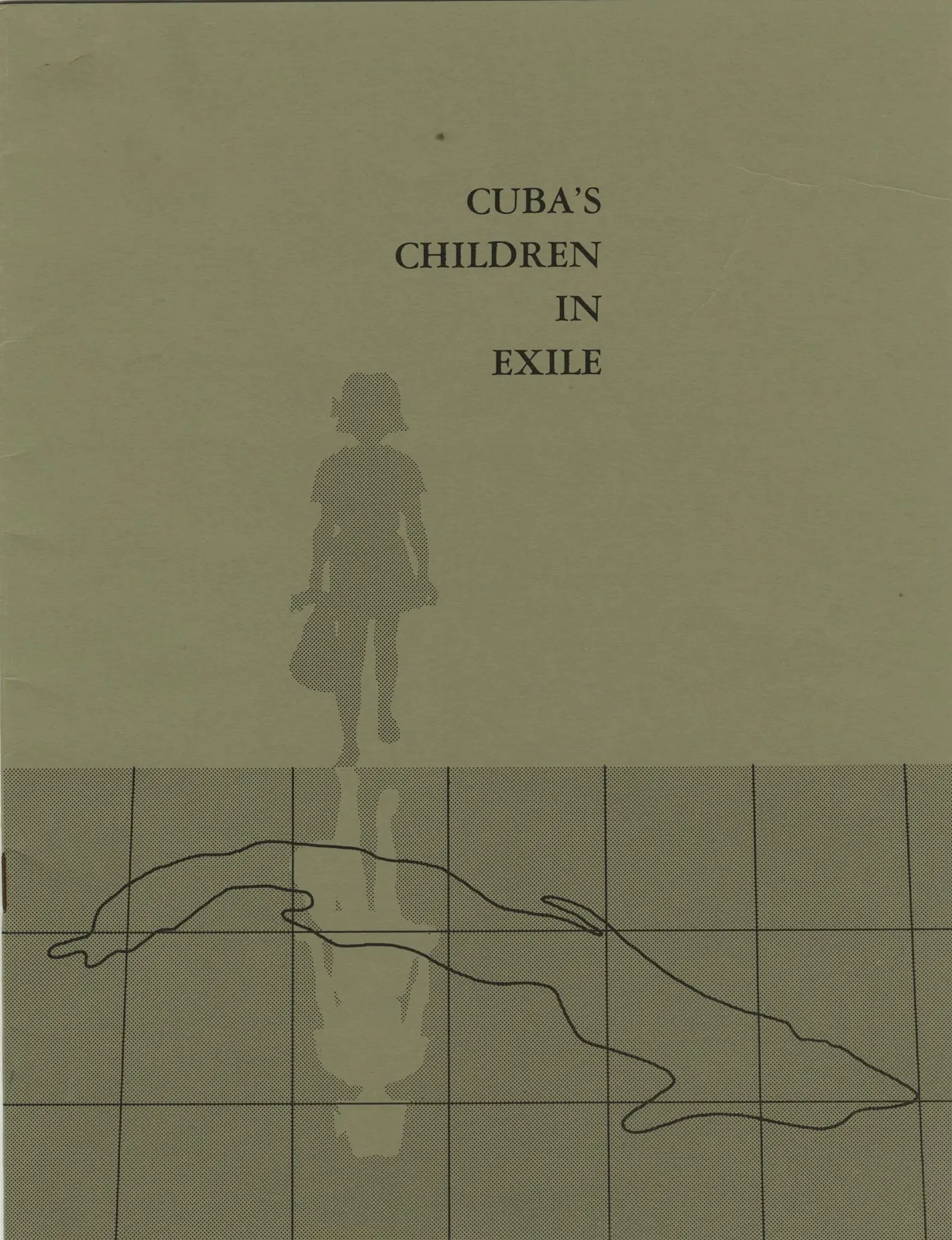
U.S. Department of Health, Education, and Welfare, Children's Bureau, Cuba's Children in Exile: The Story of the Unaccompanied Cuban Refugee Children's Program, 1967, pp. 1-6. https://cdn.prod.website-files.com/6007cfcbaf10177efef718a2/600a1150f86646309098edc8_CubasChildreninExile2.pdf back back back back back back back back back back back back back back back back back back back back
-
Interview with Monsignor Bryan O. Walsh, December 3, 1998, Barry University Oral History, transcript published by Operation Pedro Pan Group. https://cdn.prod.website-files.com/6007cfcbaf10177efef718a2/600a123a29ee03aa945ea394_Msgr.-Bryan-O.-Walsh-interview-December-3-1998-Barry-University-Oral-History.pdf back back back back back back
-
John G. Hubbell, "Operation Pedro Pan," Reader's Digest, February 1988, reproduced in Operation Pedro Pan Instructional Resource Packet (see note 6), reading no. 2. https://cdn.prod.website-files.com/6007cfcbaf10177efef718a2/600a0621d9a6b639a9d35836_Operation_Pedro_Pan_Instructional_Resource_Packet.pdf back back back
-
Gene Miller, "Operation Pedro Pan: Cuban Tots, a Raggedy Ann Doll," The Evansville Press, March 10, 1962, reproduced in Miami-Dade County Public Schools and Operation Pedro Pan Group, Operation Pedro Pan Instructional Resource Packet, October 2011, reading no. 3. https://cdn.prod.website-files.com/6007cfcbaf10177efef718a2/600a0621d9a6b639a9d35836_Operation_Pedro_Pan_Instructional_Resource_Packet.pdf back back back back back back back
-
Testimony of Wendel N. Rollason, director of the Inter-American Affairs Commission of Miami, in the Senate hearings of December 1961, p. 159, cited in Walsh, "Cuban Refugee Children" (see note 1), note 7. https://doi.org/10.2307/174929 back
-
EcuRed, "Operación Peter Pan" [Operation Peter Pan], accessed November 11, 2026. Quotation translated from Spanish. EcuRed is the Cuban state's online encyclopedia; the article cites Ramón Torreira Crespo and José Buajasán Marrawi, Operación Peter Pan: un caso de guerra psicológica contra Cuba, Editora Política, Havana, 2000. https://www.ecured.cu/Operaci%C3%B3n_Peter_Pan back back
-
"Memorandum No. 1 From the Cuba Study Group to President Kennedy," June 13, 1961, in Foreign Relations of the United States, 1961-1963, vol. X, Cuba, January 1961-September 1962, document 231. https://history.state.gov/historicaldocuments/frus1961-63v10/d231 back
-
Torres v. Central Intelligence Agency, 39 F. Supp. 2d 960 (N.D. Ill. 1999), opinion of Judge Shadur, March 12, 1999, including note 4. https://law.justia.com/cases/federal/district-courts/FSupp2/39/960/2286302/ back
-
Operation Pedro Pan Group, "Camps & Becas," accessed November 11, 2026. https://www.pedropan.org/camps-becas back
-
Barry University Archives and Special Collections, "Monsignor Bryan O. Walsh Papers" (ASC0001), collection guide, accessed November 11, 2026. https://eguides.barry.edu/c.php?g=287071&p=1912060 back back
-
Marjorie L. Donohoue, "Operation Pedro Pan: How thousands of children shuffled under Castro's nose," The Miami Voice, March 3, 1978, reproduced in Operation Pedro Pan Instructional Resource Packet (see note 6), reading no. 1. https://cdn.prod.website-files.com/6007cfcbaf10177efef718a2/600a0621d9a6b639a9d35836_Operation_Pedro_Pan_Instructional_Resource_Packet.pdf back
-
John F. Kennedy, "Statement by the President Following a Conference With Secretary Ribicoff on Cuban Refugee Problems," February 3, 1961, The American Presidency Project. https://www.presidency.ucsb.edu/node/234967 back
-
Operation Pedro Pan Group, "Resources," with the list of digitized primary sources, among them Gene Miller's article in The Miami Herald of March 9, 1962, accessed November 11, 2026. https://www.pedropan.org/resources back back
-
FIU Institute for Cuban Studies, "Chronology of U.S.-Cuba Relations," accessed November 11, 2026. https://cri.fiu.edu/us-cuba-relations/chronology-of-us-cuba-relations/ back
-
University of Miami Libraries, Cuban Heritage Collection, "Cuban Refugee Center Records (CHC0218)," finding aid, subseries "Unaccompanied Cuban Children's Program." https://atom.library.miami.edu/downloads/chc0218.pdf back