1959-1962
The First Exile
From Batista's flight to the end of the airlift in the October Crisis
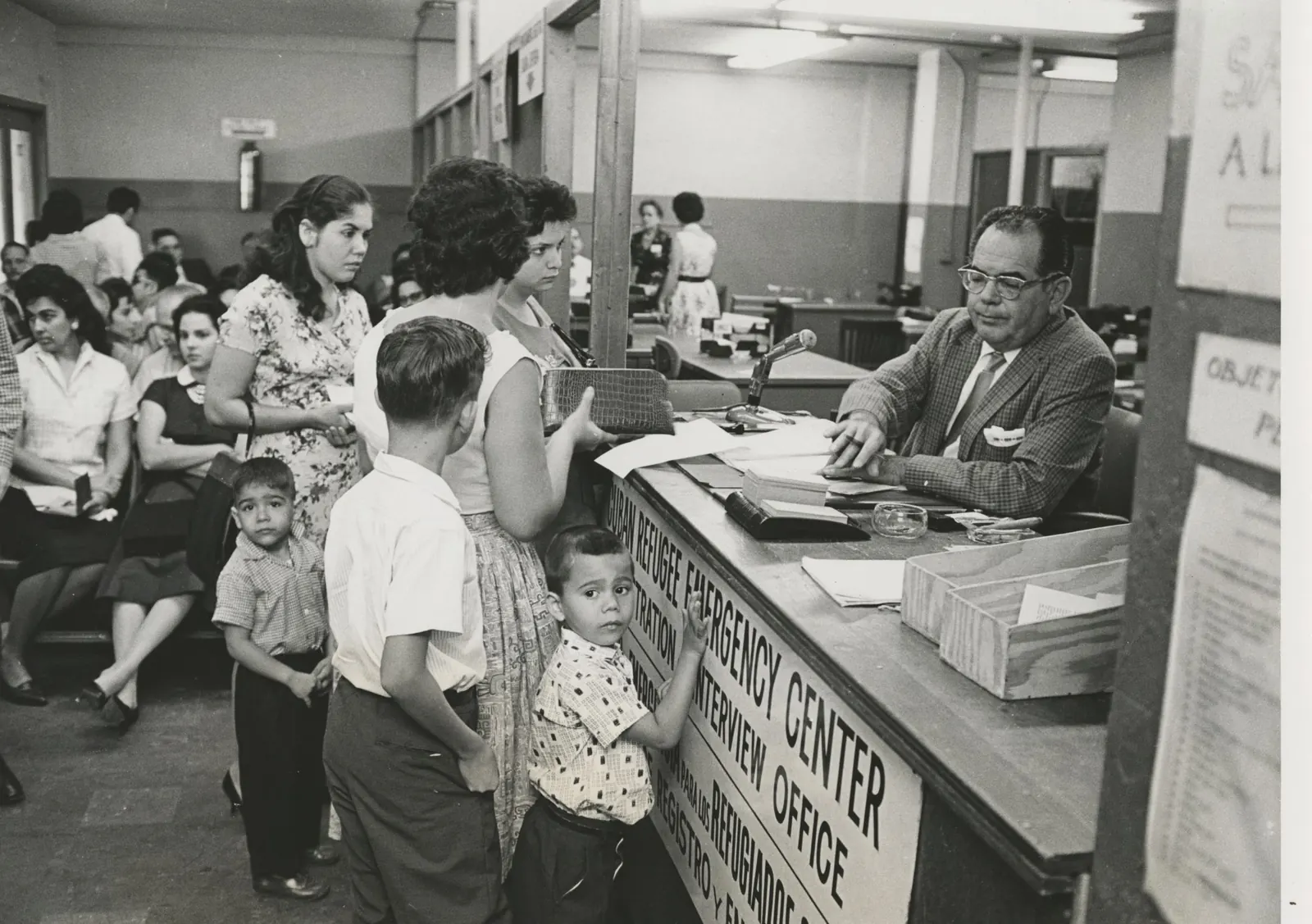
On New Year's Eve 1958, Fulgencio Batista left Cuba with his closest associates. A general strike in early January forced the military government he left behind to hand power to the 26th of July Movement, and Fidel Castro entered Havana on January 8, 1959.1 That flight set off a migration that, in less than four years, would bring nearly a quarter of a million people to the United States and force Washington to improvise what the federal government itself called "the most comprehensive program ever devised in this country to meet the needs of incoming refugees."2
The first to leave
The first exiles were the defeated. According to the Congressional Research Service (CRS), the emigres who arrived in 1958 and the first months of 1959 were mostly supporters of Batista, the military officer who had taken power in the 1952 coup.3 John F. Thomas, who later directed the federal Cuban refugee program, described that first wave as "mainly those who had some connection with the Batista government and were fleeing for political reasons," and called the group small, "numbering only a few thousands."4
The makeup changed quickly. In May 1959 the government passed the first Agrarian Reform Law, which eliminated the large private estates; in July 1960 it began nationalizing U.S.-owned companies without compensation, including 21 sugar mills, utilities and banks; in October of that year Eisenhower imposed a partial trade embargo.1 Ellen Winston, Commissioner of Welfare at the Department of Health, Education, and Welfare (HEW), summarized for Congress in 1966 the sequence her office had watched: starting in 1959, with agrarian reform and the first confiscations, "large numbers of Cubans began to seek asylum in the United States"; the flow continued in 1960 as private businesses were seized; and in late 1961 and early 1962, when the state took over management of the seized properties, "professionals and technicians of all types began to depart from Cuba."5

The middle class packs up
By 1961, according to a 1980 Heritage Foundation report that lists the work of sociologist Juan M. Clark among its sources, owners and professionals made up 45 percent of those registered in the Cuban Refugee Program. By the end of the first phase, however, more than half of the registrants were office workers, salespeople and skilled laborers: this was no longer an exodus of elites.6 Thomas described it in similar terms: by the middle of 1961, small merchants, office employees, and skilled and semiskilled workers were leaving "in large numbers," nearly all of them in the most productive years of their lives.4
Those who came in 1959 and much of 1960 could still bring money. Toward the end of 1960 the Cuban government began confiscating the real and personal property of those leaving, and refugees started arriving with nothing.4 A 1967 University of Miami study, cited by Monsignor Bryan O. Walsh, specified that each departing refugee could take only five U.S. dollars and personal belongings, and that later no money at all was allowed out.7 In December 1961 a Cuban law nationalized the private property of everyone who left the country.1
How many came
There is no single official annual series of arrivals for these years. Registration at the federal center in Miami was voluntary, and many of the earliest exiles, who brought some wealth, had bank accounts or friends in the United States and did not need to register.8 The available figures complement one another:
| Moment | Indicator | Figure | Source |
|---|---|---|---|
| End of 1960 | Cubans arrived since 1959 | between about 40,000 and more than 50,000 | NPS9; Thomas4 |
| February 3, 1961 | Cubans in the U.S. according to Immigration | 66,000, at least 32,000 of them in Miami | White House10 |
| 1962 | Arrivals during the year | about 78,000 | CRS3 |
| 1962 | Pace of arrivals | between 1,500 and 2,000 per week | HEW and University of Miami511 |
| October 1962 | Registered at the Refugee Center | between 153,000 and 155,000 | Winston5; Thomas4 |
| January 1959 to October 1962 | Departures for the U.S. | 248,070 | FIU; Heritage16 |
The contrast with admissions as lawful permanent residents (LPRs) shows the underlying problem. According to the series that the Pew Research Center reconstructs from the yearbooks of the Immigration and Naturalization Service (INS), in fiscal years 1959, 1960, 1961 and 1962 about 7,000, 8,300, 14,300 and 16,300 Cubans, respectively, obtained permanent residence.12 Tens of thousands of people arrived every year; only a fraction did so with an immigrant visa. According to the Library of Congress, the Cuban population of the United States grew from about 79,000 in 1960 to 439,000 in 1970.13

Visas, waivers and parole: a provisional status
While U.S. consulates remained open in Cuba, many left on nonimmigrant visas, as tourists or students. Attorney General Nicholas Katzenbach told Congress in 1966 that about 47,000 Cubans who still lacked permanent residence had been "admitted on nonimmigrant visas issued by U.S. consuls before their withdrawal from Cuba on January 3, 1961."14 On that day the United States broke diplomatic relations with Havana, citing what it called "crippling limitations" the Cuban government had placed on its mission's work.15
Without consulates, the normal route was closed. The State Department then turned to visa waivers. Robert F. Hale, director of the Visa Office, explained to the Senate in December 1961 that the Department had concluded it should ask the Department of Justice "to act jointly in waiving the visa requirement, pursuant to Section 212 (d) (4) (A) of the Immigration and Nationality Act, in individual cases involving specific elements of unforeseen emergency."16 The process, according to Thomas, began with a relative or friend in the United States; the federal agencies processed the application and forwarded it to the Swiss Embassy in Havana, which represented U.S. interests; the Cuban, once notified of his clearance, bought a ticket on one of the commercial airlines still operating between Havana and Miami.4
On arrival, most did not receive residence. The federal program defined a Cuban refugee as someone with INS documentation as a parolee (a person admitted on temporary humanitarian permission under section 212(d)(5) of that act), as a beneficiary of indefinite voluntary departure, as a permanent resident, or as a student.17 As of June 30, 1966, 115,101 Cubans were in parole status and 47,080 in voluntary departure; since 1959 only about 75,000 had been admitted as permanent residents.18
Leaving that provisional status was difficult. The Immigration and Nationality Act did not allow natives of Western Hemisphere countries to adjust their status inside the United States: they had to leave the country and obtain an immigrant visa at a consulate abroad.14 For a Cuban that meant traveling to cities such as Toronto, Windsor, Mexico City or Nassau, or to Spain, because in his own country there was no longer a consul.18 Deputy Attorney General Ramsey Clark wrote in 1966 that "somewhat in excess of 164,000 Cubans" had come to the United States and remained "in an indefinite and nonresident status," and that since January 3, 1961 it had been "impossible" for a Cuban proceeding directly from the island to apply for an immigrant visa.19 Without residence the clock for citizenship did not run,19 and in many states one could not practice as a physician, dentist, lawyer or teacher without being a citizen or resident.5 Winston put it this way to Congress: thousands had been in the country seven years and had children born here, American citizens, and their parents remained "suspended in limbo."5 That is the situation the Cuban Adjustment Act came to resolve in 1966, as told in the birth of the act.
From the Emergency Center to the Cuban Refugee Program
During 1959 and much of 1960, help for the new arrivals came from Miami's own Cuban community and from local public and voluntary agencies. By late 1960 those resources were stretched to the limit.47 In November, Eisenhower named Tracy Voorhees his personal representative for the problem, and on December 2 he gave him additional funds and powers.20 In December the Cuban Refugee Emergency Center opened in Miami, financed with $1 million from the President's contingency fund under the Mutual Security Act.4 Cardinal Spellman welcomed that $1 million allocation by telegram and sent a $10,000 check; Eisenhower replied praising the work of the Diocese of Miami under Bishop Coleman Carroll.21
Voorhees delivered an interim report on December 19, 1960, and a final one, with ten recommendations, which Eisenhower released on January 18, 1961, two days before leaving the White House.20 In the accompanying statement, the outgoing president wrote:
"This latest exodus of persons fleeing from Communist oppression is the first time in many years in which our nation has become the country of first asylum for any such number of refugees. [...] Our people opened their homes and hearts to the Hungarian refugees four years ago. I am sure we will do no less for these distressed Cubans." Dwight D. Eisenhower, January 18, 196120
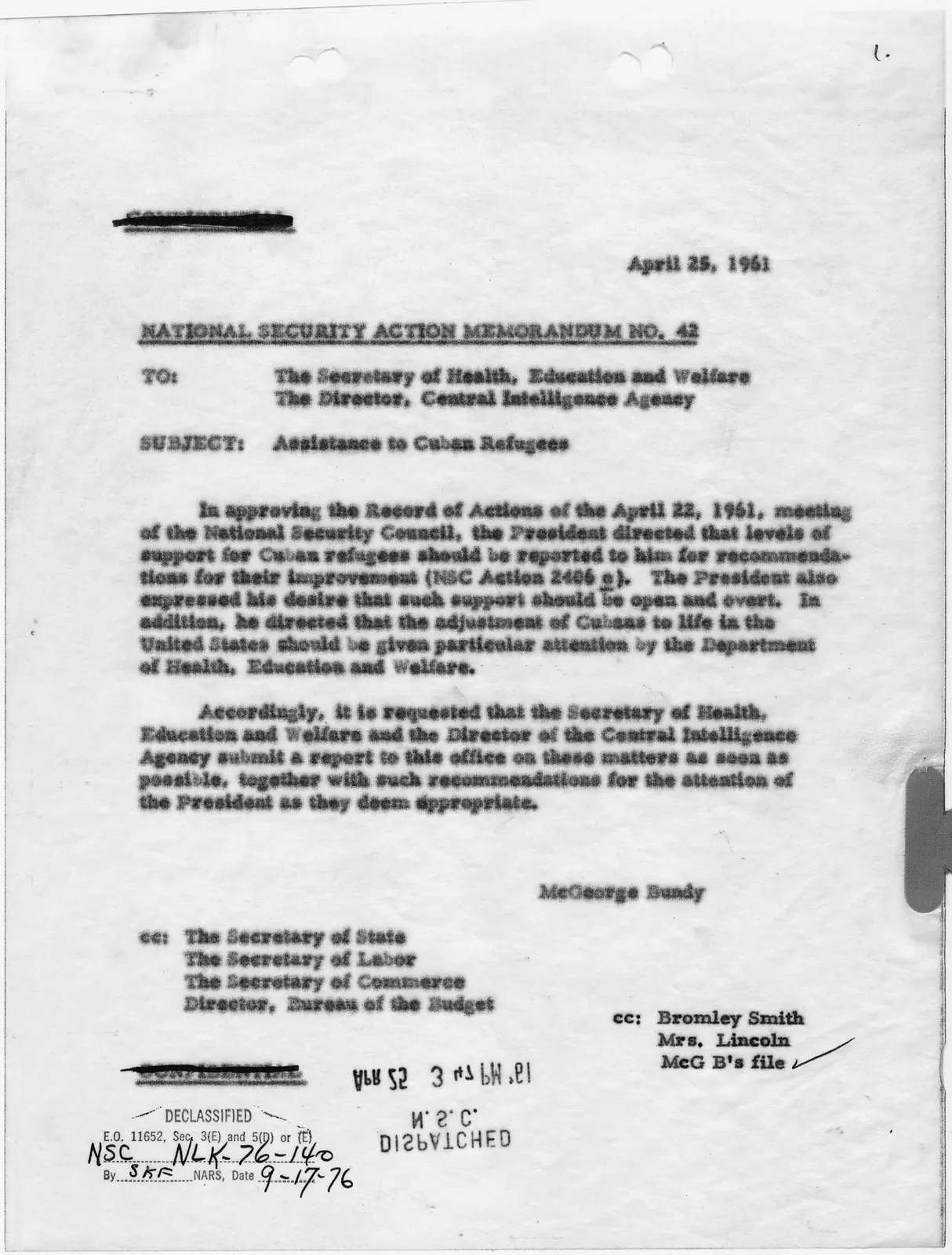
Kennedy took up the matter in his first week. On January 27, 1961, he asked the Secretary of Health, Education, and Welfare, Abraham Ribicoff, to take over direction of all federal activities for Cuban refugees as of February 1 and to go to Miami to see the situation in person; in the letter he invoked the tradition of the United States as a haven for those who are "exiles for conscience's sake."22 On February 3, after receiving Ribicoff's report, Kennedy announced a nine-point program: support for voluntary agencies, employment, funds to resettle refugees outside Miami, financial help for needy families, health services, money for public schools receiving Cuban children, professional retraining for doctors, teachers and other professionals, protection of unaccompanied minors, and distribution of surplus agricultural commodities.10 The statement put at 66,000 the Cubans already in the country and estimated the cost of those measures at about $4 million through the end of the fiscal year. It added a revealing detail: three quarters of the faculty of the University of Havana were, according to reports, in South Florida.10
That is how the Cuban Refugee Program was born. Ribicoff delegated its administration to the Commissioner of Social Security, William L. Mitchell, and the Florida Department of Public Welfare opened an office in Miami that, on behalf of the federal government, handled assistance, child welfare services and medical care.11 The spending figures show the scale: $4.1 million in fiscal year 1961, $38.5 million in 1962 and $56 million in 1963.23 On June 28, 1962, Congress passed the Migration and Refugee Assistance Act of 1962 (Public Law 87-510), which gave the program a stable legal basis and allowed it to be financed with annual appropriations.4
The aid was modest: after the October Crisis, according to Thomas, an assisted family received $100 a month and a single person $60.23 On top of that came surplus federal food, medical care, loans for college students, and English and professional retraining courses.11 By 1961 nearly 700 Cuban physicians were already in exile in the country, and that year the University of Miami created an intensive three-month course to prepare them for the examination the United States required of foreign graduates; the same year Iowa devised a plan for Cuban lawyers and teachers to obtain a temporary license and teach Spanish in its schools.6 The government also decided not to open camps: Cubans were, in the term Thomas took from postwar European usage, "free-livers," that is, with "no restrictions as to movement, residence, or employment."23
"El Refugio": the Freedom Tower
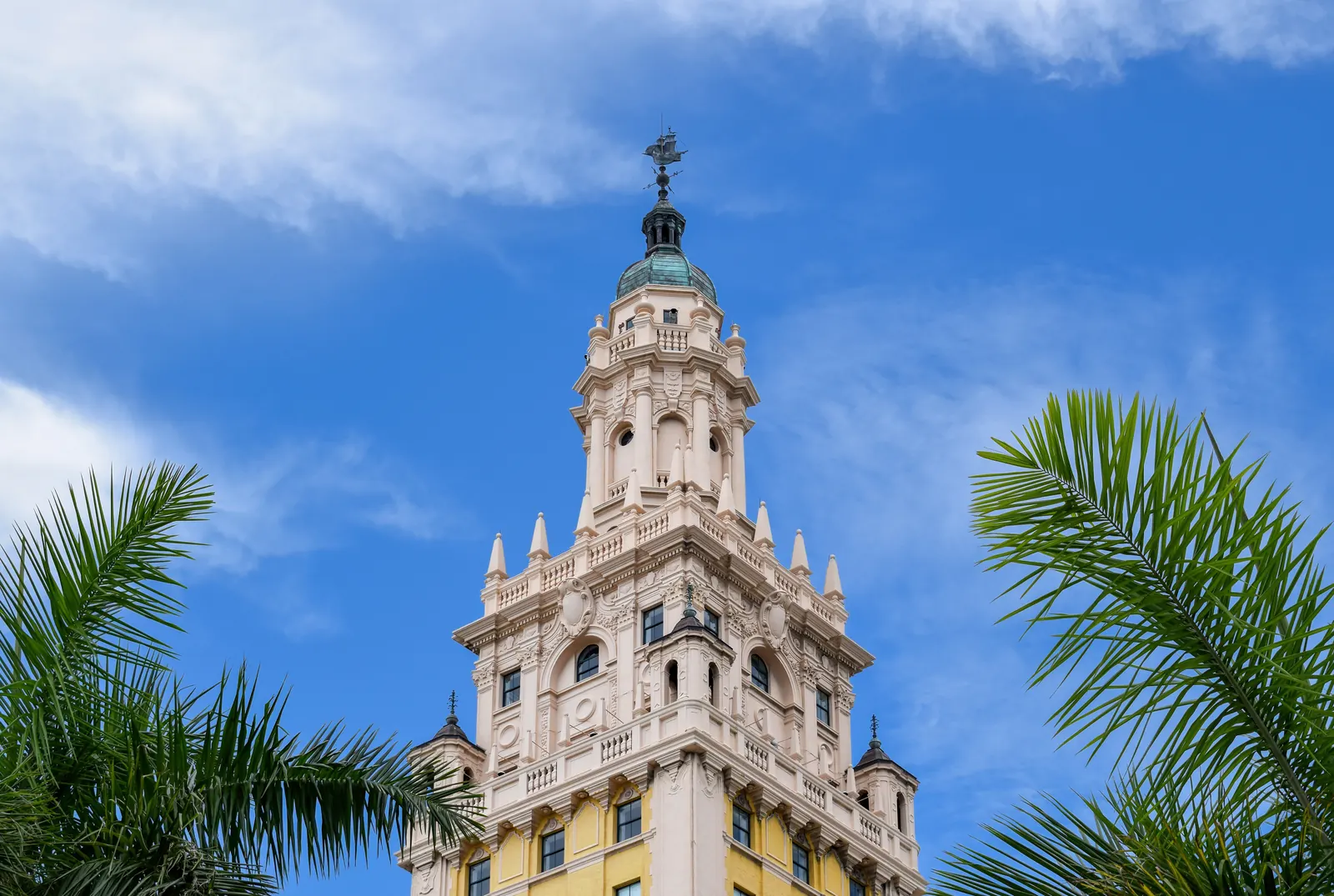
On July 1, 1962, the federal General Services Administration began leasing the first floors of the tower that the Miami News had left vacant in 1957, at 600 Biscayne Boulevard. Inspired by the Giralda in Seville, the building was renamed with simple gold letters: The Freedom Tower. Cubans called it "El Refugio."9
There, arrivals were processed: interview, identification card, medical and dental exam, a search for relatives already settled in the country, financial aid, and rations of cheese and canned meat from federal surplus. Much of the staff was Cuban.9 The center operated in the tower until 1974. The National Park Service (NPS), which has counted it among the National Historic Landmarks since October 6, 2008, calls it the "Ellis Island of the South" and estimates that the federal government spent $957 million on the program between 1959 and 1974.9
Leaving Miami: resettlement
Miami could not absorb everyone. Resettlement was from the start one of the program's pillars, and to carry it out the government contracted four national voluntary agencies: the National Catholic Welfare Conference (NCWC), Church World Service, the International Rescue Committee (IRC) and the Jewish service United HIAS.5 Results were slow to come. In October 1962, according to Winston, the great majority of registrants were still in Miami and more than 68,000 were receiving federal financial assistance;5 Thomas put it at nearly 70,000, 58 percent of the refugees then living in the area.23 The big resettlement campaign, with tens of thousands of families sent to New York, New Jersey, California or Illinois, would come in the following years, as told in the closed-door years.
The Bay of Pigs and the last year of flights
In March 1960 Eisenhower had ordered the CIA to prepare a plan to overthrow Castro's government with a force of exiles, Brigade 2506. Kennedy inherited it and authorized it. On April 17, 1961, the brigade landed at the Bay of Pigs and was defeated in two days; according to the State Department's Office of the Historian, the failure strengthened the Cuban government, which openly proclaimed its intention to adopt socialism.24 About 1,197 exiles were taken prisoner.1 Their release, in exchange for food and medicine, is part of the story of the closed-door years.
In the months that followed, departures kept growing. In June 1961 Catholic and private schools were closed, one of the reasons that, according to Operation Pedro Pan Group, led thousands of families to send their children alone, as told in Operation Pedro Pan.25 In 1962, the year of greatest inflow of this phase, about 78,000 people arrived,3 at a pace of about 1,800 per week.4 By October between 153,000 and 155,000 Cubans had registered at the Miami center.54
October 1962: the airlift closes
On October 14, 1962, a U-2 spy plane photographed Soviet nuclear missile sites under construction in Cuba. On October 22, Kennedy announced a naval "quarantine" of the island.26 In retaliation, the Cuban government suspended all commercial flights to the United States.4 HEW recorded it this way in a 1967 report: the children kept arriving "until all commercial flights from Cuba to the United States were suspended by the Castro government following President Kennedy's public statement on missiles in Cuba."27
With the last flight the first phase of the exile ended, the one the Institute for Cuban Studies at Florida International University (FIU) calls the "Historical exile": 248,070 people between January 1959 and October 1962.128 Behind them lay thousands of split families, with children in Miami and parents in Havana, and ahead lay three years without direct flights in which leaving Cuba would mean passing through a third country or risking one's life at sea.
Notes and sources
-
FIU Institute for Cuban Studies, "Chronology of U.S.-Cuba Relations," accessed November 11, 2026. https://cri.fiu.edu/us-cuba-relations/chronology-of-us-cuba-relations/ back back back back back back
-
U.S. Department of Health, Education, and Welfare, Children's Bureau, Cuba's Children in Exile: The Story of the Unaccompanied Cuban Refugee Children's Program, 1967, foreword by Katherine B. Oettinger and John F. Thomas. https://cdn.prod.website-files.com/6007cfcbaf10177efef718a2/600a1150f86646309098edc8_CubasChildreninExile2.pdf back
-
Ruth Ellen Wasem, "Cuban Migration to the United States: Policy and Trends," Congressional Research Service, report R40566, June 2, 2009, p. 1. https://www.everycrsreport.com/files/20090602_R40566_5c818df5cf6f61aac828f7e487dfe38f29f6dce4.pdf back back back
-
John F. Thomas, "Cuban Refugees in the United States," International Migration Review, vol. 1, no. 2, 1967, pp. 46-48. Thomas was director of HEW's Cuban Refugee Program. Digitized copy on the Operation Pedro Pan Group site: https://cdn.prod.website-files.com/6007cfcbaf10177efef718a2/600a1511cd3d7609f4dd31e6_1966JohnF.ThomasCubanRefugeesintheUnitedStates_0.pdf (DOI: https://doi.org/10.2307/3002808). back back back back back back back back back back back back
-
Statement of Ellen Winston, HEW Commissioner of Welfare, in U.S. House of Representatives, Committee on the Judiciary, Subcommittee No. 1, Adjustment of Status for Cuban Refugees: Hearings on H.R. 15182, H.R. 15183, H.R. 16908, H.R. 10808 and H.R. 13393, 89th Congress, 2nd session, August 10, 11 and 17, 1966, Serial No. 20, pp. 49-53. https://www.govinfo.gov/content/pkg/CHRG-89hhrg67905/pdf/CHRG-89hhrg67905.pdf back back back back back back back back
-
Sylvia Castellanos, "The Cuban Refugee Problem in Perspective, 1959-1980," Heritage Foundation, Backgrounder no. 124, July 18, 1980, pp. 3-6, which cites among its sources Juan M. Clark, The Exodus from Revolutionary Cuba (1959-1974): A Sociological Analysis, doctoral dissertation, University of Florida, 1975. https://policyarchive.org/download/8923 back back back
-
Bryan O. Walsh, "Cuban Refugee Children," Journal of Interamerican Studies and World Affairs, vol. 13, no. 3-4, October 1971, pp. 378-415, notes 11 and 12, which cite The Cuban Migration 1959-1960 (Research Institute for Cuba and the Caribbean, University of Miami, 1967), p. 24. https://doi.org/10.2307/174929 back back
-
Statement of John F. Thomas, director of the Cuban Refugee Program, in Adjustment of Status for Cuban Refugees (see note 5), p. 58. https://www.govinfo.gov/content/pkg/CHRG-89hhrg67905/pdf/CHRG-89hhrg67905.pdf back
-
National Park Service, "Freedom Tower," accessed November 11, 2026. https://www.nps.gov/places/freedom-tower.htm back back back back
-
John F. Kennedy, "Statement by the President Following a Conference With Secretary Ribicoff on Cuban Refugee Problems," February 3, 1961, The American Presidency Project. https://www.presidency.ucsb.edu/node/234967 back back back
-
University of Miami Libraries, Cuban Heritage Collection, "Cuban Refugee Center Records (CHC0218)," finding aid, administrative and historical note, p. 4. https://atom.library.miami.edu/downloads/chc0218.pdf back back back
-
Pew Research Center, "Cuban immigration waves, 1950 to 2024," chart published May 7, 2026, with data on permanent resident admissions by fiscal year taken from INS yearbooks and annual reports. https://www.pewresearch.org/chart/sr_26-04-28_cubanamericans_arrivals/ back
-
Library of Congress, "1966: The Cuban Adjustment Act of 1966," in A Latinx Resource Guide: Civil Rights Cases and Events in the United States, accessed November 11, 2026. https://guides.loc.gov/latinx-civil-rights/cuban-adjustment-act back
-
Statement of Attorney General Nicholas deB. Katzenbach in Adjustment of Status for Cuban Refugees (see note 5), pp. 30-31. https://www.govinfo.gov/content/pkg/CHRG-89hhrg67905/pdf/CHRG-89hhrg67905.pdf back back
-
Office of the Historian, U.S. Department of State, "A Guide to the United States' History of Recognition, Diplomatic, and Consular Relations, by Country, since 1776: Cuba," accessed November 11, 2026. https://history.state.gov/countries/cuba back
-
Testimony of Robert F. Hale, director of the Visa Office of the Department of State, before the Senate Subcommittee to Investigate Problems Connected with Refugees and Escapees, 87th Congress, 1st session, December 6, 7 and 13, 1961, quoted in Walsh, "Cuban Refugee Children" (see note 7), note 18. https://doi.org/10.2307/174929 back
-
Thomas, "Cuban Refugees in the United States" (see note 4), appendix A, "Definition of a Cuban Refugee," pp. 56-57. back
-
Question from subcommittee chairman Michael A. Feighan and answers from Under Secretary of State George Ball in Adjustment of Status for Cuban Refugees (see note 5), p. 10. https://www.govinfo.gov/content/pkg/CHRG-89hhrg67905/pdf/CHRG-89hhrg67905.pdf back back
-
Letter from Deputy Attorney General Ramsey Clark to the chairman of the Judiciary Committee, reproduced in Adjustment of Status for Cuban Refugees (see note 5), pp. 8-9. https://www.govinfo.gov/content/pkg/CHRG-89hhrg67905/pdf/CHRG-89hhrg67905.pdf back back
-
Dwight D. Eisenhower, "Statement by the President on Releasing a Report on Cuban Refugee Problems," January 18, 1961, The American Presidency Project. https://www.presidency.ucsb.edu/node/234969 back back back
-
Dwight D. Eisenhower, "Letter to Cardinal Spellman Concerning Aid to Cuban Refugees," December 9, 1960, and editorial note on the cardinal's telegram, The American Presidency Project. https://www.presidency.ucsb.edu/node/234637 back
-
John F. Kennedy, "Letter to Secretary Ribicoff Requesting Him To Undertake Direction of Cuban Refugee Activities," January 27, 1961, The American Presidency Project. https://www.presidency.ucsb.edu/node/236183 back
-
Thomas, "Cuban Refugees in the United States" (see note 4), pp. 48-51 and table I, "Financing of the Cuban Refugee Program." Spending figures are obligations by fiscal year. back back back back
-
Office of the Historian, U.S. Department of State, "The Bay of Pigs Invasion and its Aftermath, April 1961-October 1962," Milestones series, accessed November 11, 2026. https://history.state.gov/milestones/1961-1968/bay-of-pigs back
-
Operation Pedro Pan Group, "History," accessed November 11, 2026. https://www.pedropan.org/history back
-
Office of the Historian, U.S. Department of State, "The Cuban Missile Crisis, October 1962," Milestones series, accessed November 11, 2026. https://history.state.gov/milestones/1961-1968/cuban-missile-crisis back
-
U.S. Department of Health, Education, and Welfare, Children's Bureau, Cuba's Children in Exile: The Story of the Unaccompanied Cuban Refugee Children's Program, 1967, p. 4. https://cdn.prod.website-files.com/6007cfcbaf10177efef718a2/600a1150f86646309098edc8_CubasChildreninExile2.pdf back
-
FIU Institute for Cuban Studies, "Brief History of Cuban Migration," accessed November 11, 2026. https://cri.fiu.edu/cuban-american/cuban-migration/ back