1962-1965
The Closed-Door Years
Three years without direct flights: the Bay of Pigs exchange, exits through third countries, and the boats
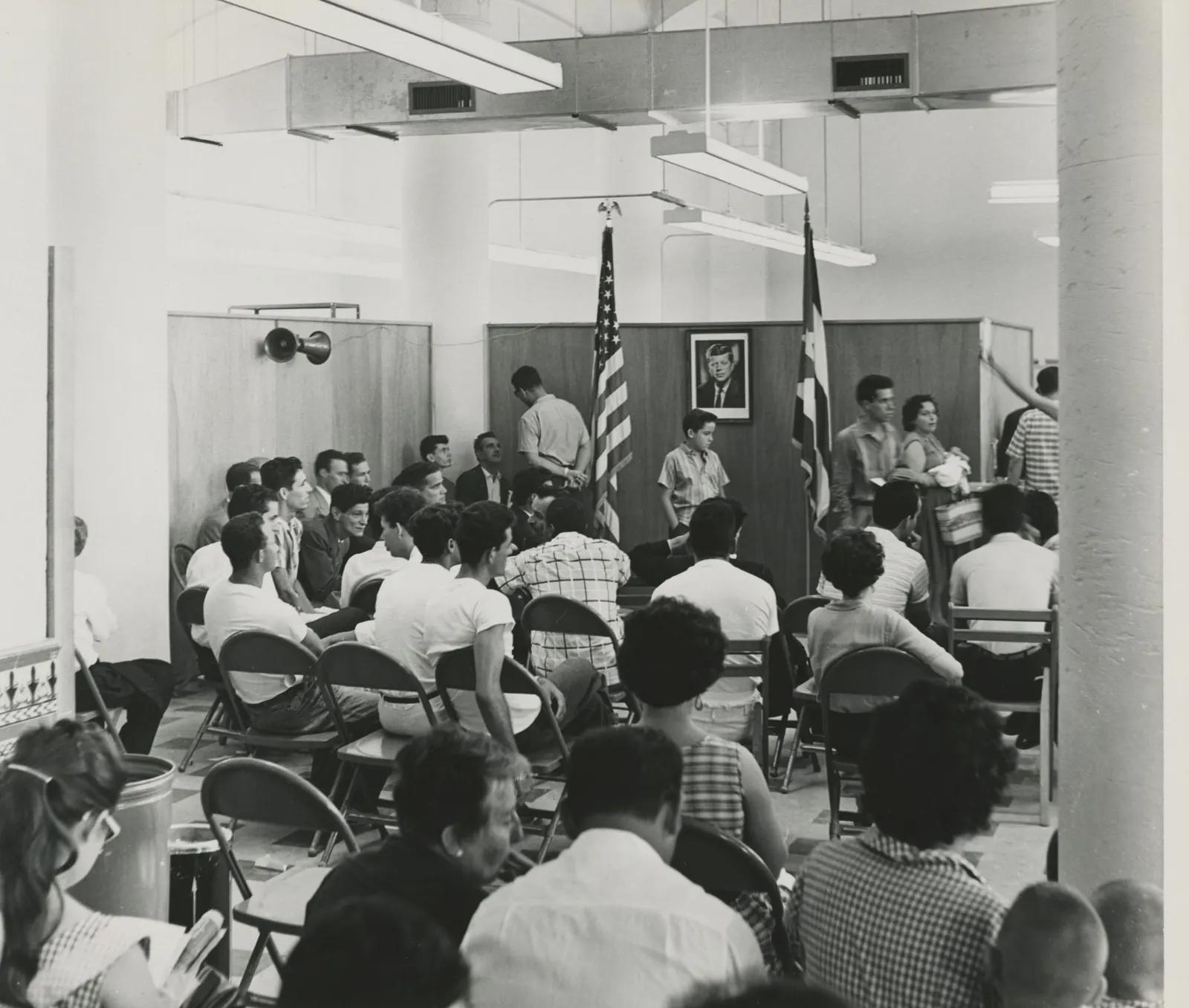
On October 22, 1962, Kennedy announced the naval quarantine of Cuba, and the Cuban government responded by suspending all commercial flights to the United States.1 In the preceding months up to 1,800 people a week had arrived in Miami.2 For the next three years, except for the exchange of the Bay of Pigs prisoners, there was no direct commercial air transportation between the two countries.1 Leaving Cuba meant first passing through a third country, finding a place on one of the Red Cross ships, or taking a chance on the Straits of Florida.
A severed bridge
The drop was immediate. Ellen Winston, Commissioner of Welfare at the Department of Health, Education, and Welfare (HEW), told Congress of a "sharp decline in arrivals" caused by the lack of transportation.2 According to the Congressional Research Service (CRS), the end of regular travel also marked the start of the dangerous practice of setting out to sea toward Florida.3
There were attempts to reopen the route. In January 1963 the attorney James B. Donovan, who had negotiated the exchange of the Bay of Pigs prisoners and was still dealing with Castro over the release of imprisoned Americans, passed on to him a Pan American proposal to operate ten flights a week, paid half in dollars and half in pesos; Castro promised to answer soon.4 Regular flights did not return. The next direct airlift began on December 1, 1965, and that is another story: that of Camarioca and the Freedom Flights.

The Bay of Pigs exchange
Of the exiles in Brigade 2506 who landed in April 1961, about 1,197 were taken prisoner.5 On December 21, 1962, Castro signed with Donovan, attorney for the Cuban Families Committee, an agreement to release 1,113 of them in exchange for $53 million in pharmaceuticals, medical supplies and food.6 A State Department telegram to its Latin American embassies, dated December 22, explained the terms: 20 percent of the goods had to be delivered in Havana before the release; the American Red Cross already had a ship loading, whose cargo three representatives of the Cuban Red Cross were inspecting in Miami, and was preparing air cargo to meet that deadline before the 23rd, the day the transfer of the prisoners to Miami was to begin; the goods, about $45 million so far, were donated by private companies, and the transportation, insurance and labor by railroads, airlines, shipping lines and unions. "No USG funds involved," the text stressed, and it described the prisoners as sick and malnourished.6 By the end of December the 1,113 men were in the United States.5
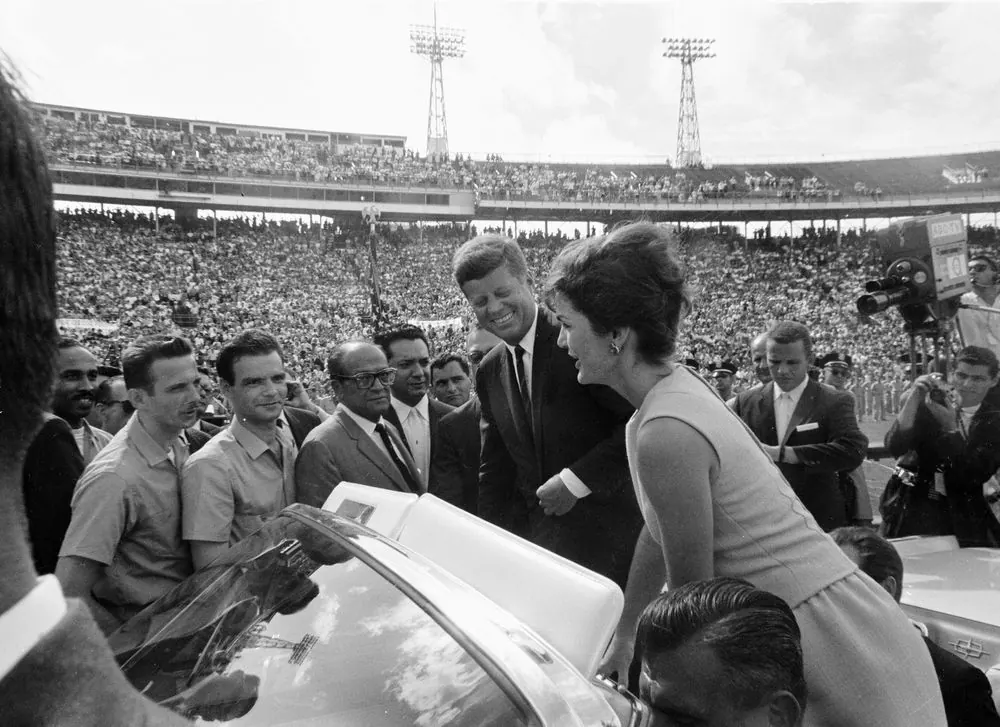
On December 29, 1962, Kennedy and his wife, Jacqueline, went to the Orange Bowl stadium in Miami. Erneido Oliva, the brigade's deputy commander, handed the president the flag that another brigade member had kept for twenty months, after escaping with it during the invasion and taking refuge in an embassy in Havana. Jacqueline Kennedy spoke briefly in Spanish.7 The president said:
"I want to express my great appreciation to the brigade for making the United States the custodian of this flag. I can assure you that this flag will be returned to this brigade in a free Havana." John F. Kennedy, Orange Bowl, Miami, December 29, 19627
Deliveries continued in the following months, by sea and by air. Between January and July 1963 the Red Cross ships and flights that carried the exchange supplies to Cuba served as an exit for U.S. citizens who wanted to leave.8 According to a 1980 Heritage Foundation report, after the crisis direct emigration was limited to "exceptional cases," such as the Bay of Pigs prisoners and their families and certain American citizens.9 A January 1963 State Department memorandum mentions the Shirley Lykes in connection with a controversy: the U.S. press reported that a disabled girl had had her crutches taken away as she boarded it, and Castro, in his meeting with Donovan on January 25, said the story was false.4
Through Spain and Mexico
For the great majority, the legal exit became a detour. The State Department itself explained in 1966 that from July 1963 Americans still in Cuba were normally able to leave on commercial transportation through third countries, "such as Spain and Mexico," after obtaining the necessary Cuban exit permission and transit visas.8 For Cubans, those two commercial routes were also the only ones left open toward the United States.10 According to HEW, those who reached Mexico or Spain arrived without funds, could not work while waiting for a U.S. visa to be decided, and many suffered "severe social and economic hardships."10
The State Department's figures give the measure of that wait. In 1966 Under Secretary George Ball estimated that about 46,000 Cuban refugees were living in other countries: 15,000 in Spain, 10,300 in Mexico, 10,000 in Venezuela, 2,000 in Panama and smaller numbers in fifteen other Latin American countries. Jamaica, another possible stopover, had only 64.11 U.S. consulates in Spain and Mexico had been granting immigrant visas to Cubans at a pace of about 300 and 500 a month, respectively, the year before.11
Among those waiting were the parents of the minors of Operation Pedro Pan. In 1964 the Cuban Refugee Program agreed with the Departments of State and Justice on a procedure to bring them with priority from Spain and Mexico, and the agencies' watchword was to take the parents to the city where their children already lived rather than return the children to Miami.10
By sea
The other way out was the sea. According to the 1980 Heritage Foundation report, which lists the work of sociologist Juan M. Clark among its sources, of the 55,916 Cubans who left the island between 1962 and 1965 a "large percentage" did so on dangerous boat journeys, and the rest flew first to Mexico or Spain in the hope of later entering the United States. The profile also changed: in 1963, most of those who risked the crossing to the Florida Keys were farmers and laborers.9
The sources consulted for this chapter do not offer an official series of arrivals by sea in these years. What is on record is how those who made it were received. John F. Thomas, director of the Cuban Refugee Program, explained in 1966 that there was an "almost automatic arrangement" with the Immigration and Naturalization Service (INS) and the Coast Guard: when a boat was picked up in the channel, its occupants, who "most of the time" arrived destitute, without water, without food, and sometimes injured, were referred to the Miami Refugee Center.12
How many arrived
No source gives a single figure. The 55,916 departures between 1962 and 1965 reported by the Heritage report count those who left Cuba, not only those who arrived in the United States.9 The series of admissions as lawful permanent residents that the Pew Research Center reconstructs from INS data offers another perspective:
| Fiscal year | Cubans admitted as lawful permanent residents |
|---|---|
| 1963 | about 10,600 |
| 1964 | about 15,800 |
| 1965 | about 19,800 |
Source: Pew Research Center, with INS data.13
Those admissions are not the same as arrivals. They include people who entered from Spain or Mexico on immigrant visas and also Cubans already living in the United States who went to a consulate in Canada or Mexico to come back with residence, as was discussed in Congress in 1966.1114 What the sources agree on is that the pace of 1961 and 1962 did not recover until the 1965 airlift.
Miami empties out
The slowdown in arrivals gave the federal government a breather that it used to change tactics. According to Winston, HEW interviewed the refugees in Miami one by one, coded the information for processing on data equipment, and separated those who could accept resettlement right away from those who needed prior preparation.2 The four voluntary resettlement agencies reviewed the whole caseload with federal staff and, when it was decided that a family could be resettled, its financial aid was withdrawn if it refused a reasonable offer.15
It was not an easy offer to accept. Aid in Miami, $100 a month per family and $60 for a single person, was not enough to hold anyone back; what kept people in the city, according to Thomas, was the climate, the closeness of Cuba, the hope of a quick return and the political activity among "400 or more" exile organizations.15 Even so, in less than two years of concentrated effort the number of people receiving financial assistance in Miami fell to fewer than 12,000, mostly over 65, and Cubans had spread across nearly 3,000 communities in every state.15 Winston gave another measure of the change in 1966: through October 3, 1965, more than 93,000 refugees had been resettled outside Miami since the start of the program, and the number of people on public assistance in the city had dropped from 68,000 in October 1962 to 17,000.2
The map of that distribution, with Refugee Center data from June 1961 to December 1966, shows where the country's other Cuban communities were born: 37,345 people resettled in New York, 19,953 in New Jersey, 14,194 in California, 13,323 in Puerto Rico and 8,662 in Illinois, among other destinations. Thomas highlighted the clusters in New York City; in Elizabeth, Union City and West New York in New Jersey; and in Chicago, New Orleans and Los Angeles.16
Inside Miami, the program changed as well. In 1963 the newly created Welfare Administration replaced Social Security at the head of the program, and the smaller number of arriving refugees, together with home visits, allowed a move from emergency response to more orderly management.17 In 1964 the Center launched "Training for Independence," aimed at 3,800 Cuban women heads of household, without job skills, living in Miami's poor neighborhoods on a federal subsidy of $100 a month: receiving it came to depend on attending courses, mostly in industrial sewing, with child care for those who depended on them. According to the Heritage Foundation study, about three quarters took part and about 80 percent of those who finished the first courses quickly found steady work.9 Federal spending on the program, which had reached $56 million in fiscal year 1963, fell to $46 million in 1964 and $32.5 million in 1965.16
Papers half in order
The way of arriving decided one's status. Those who came from Spain or Mexico generally did so on an immigrant visa processed at a consulate, and so as lawful permanent residents; Ball explained in 1966 that those Cubans kept applying for "immigrant status" at the local consulates, which granted it "in due course" after the corresponding investigation.11 Those who arrived by sea, by contrast, were in the same situation as most of their predecessors. According to a timeline from the University of California, Los Angeles (UCLA) School of Law's Center for Immigration Law and Policy, between 1959 and 1965 the federal government granted parole to Cubans, including those who had entered without authorization,18 and the refugee program accepted parole or indefinite voluntary departure as proof of Cuban refugee status.19 In mid-1966, about 81,000 Cubans who had arrived before the December 1965 airlift were still in parole status, and another 47,000, also without residence, had entered before 1961 on nonimmigrant visas.14
None of them could become a resident without leaving the country. Attorney General Nicholas Katzenbach summed it up for Congress in 1966: those with money could go to Canada or Mexico, get an immigrant visa there and return; those without it could not.14 That inequality, and the limbo of tens of thousands of families, are the origin of the Cuban Adjustment Act of 1966.
September 1965
Three years after the October Crisis, the closure ended unexpectedly. On September 28, 1965, Castro announced that any Cuban with relatives in the United States who wanted to leave would be able to do so starting October 10.10 What followed, the port of Camarioca, the flotilla of boats that crossed from Florida and the Varadero airlift, is told in Camarioca and the Freedom Flights.
Notes and sources
-
John F. Thomas, "Cuban Refugees in the United States," International Migration Review, vol. 1, no. 2, 1967, p. 47. Thomas was director of HEW's Cuban Refugee Program. Digitized copy on the Operation Pedro Pan Group site: https://cdn.prod.website-files.com/6007cfcbaf10177efef718a2/600a1511cd3d7609f4dd31e6_1966JohnF.ThomasCubanRefugeesintheUnitedStates_0.pdf (DOI: https://doi.org/10.2307/3002808). back back
-
Statement of Ellen Winston, HEW Commissioner of Welfare, in U.S. House of Representatives, Committee on the Judiciary, Subcommittee No. 1, Adjustment of Status for Cuban Refugees: Hearings on H.R. 15182, H.R. 15183, H.R. 16908, H.R. 10808 and H.R. 13393, 89th Congress, 2nd session, August 10, 11 and 17, 1966, Serial No. 20, pp. 50-51. https://www.govinfo.gov/content/pkg/CHRG-89hhrg67905/pdf/CHRG-89hhrg67905.pdf back back back back
-
Ruth Ellen Wasem, "Cuban Migration to the United States: Policy and Trends," Congressional Research Service, report R40566, June 2, 2009, p. 1. https://www.everycrsreport.com/files/20090602_R40566_5c818df5cf6f61aac828f7e487dfe38f29f6dce4.pdf back
-
"Memorandum for the Files," Washington, January 26, 1963, on Donovan's January 25 meeting with Castro, in Foreign Relations of the United States, 1961-1963, vol. XI, Cuban Missile Crisis and Aftermath, document 275. https://history.state.gov/historicaldocuments/frus1961-63v11/d275 back back
-
FIU Institute for Cuban Studies, "Chronology of U.S.-Cuba Relations," accessed November 11, 2026. https://cri.fiu.edu/us-cuba-relations/chronology-of-us-cuba-relations/ back back
-
"Circular Telegram to All Latin American Posts," Washington, December 22, 1962, in Foreign Relations of the United States, 1961-1963, vol. XI, Cuban Missile Crisis and Aftermath, document 255. https://history.state.gov/historicaldocuments/frus1961-63v11/d255 back back
-
John F. Kennedy, "Remarks in Miami at the Presentation of the Flag of the Cuban Invasion Brigade," December 29, 1962, with editorial note, The American Presidency Project. https://www.presidency.ucsb.edu/node/236821 back back
-
Letter from the Department of State to the chairman of Subcommittee No. 1, Michael A. Feighan, August 19, 1966, reproduced in Adjustment of Status for Cuban Refugees (see note 2), p. 72. https://www.govinfo.gov/content/pkg/CHRG-89hhrg67905/pdf/CHRG-89hhrg67905.pdf back back
-
Sylvia Castellanos, "The Cuban Refugee Problem in Perspective, 1959-1980," Heritage Foundation, Backgrounder no. 124, July 18, 1980, pp. 3-4 and 11-12, which cites among its sources Juan M. Clark, The Exodus from Revolutionary Cuba (1959-1974): A Sociological Analysis, doctoral dissertation, University of Florida, 1975. https://policyarchive.org/download/8923 back back back back
-
U.S. Department of Health, Education, and Welfare, Children's Bureau, Cuba's Children in Exile: The Story of the Unaccompanied Cuban Refugee Children's Program, 1967, p. 4. https://cdn.prod.website-files.com/6007cfcbaf10177efef718a2/600a1150f86646309098edc8_CubasChildreninExile2.pdf back back back back
-
Answers of Under Secretary of State George Ball and table "Estimated Cuban refugees in other countries," in Adjustment of Status for Cuban Refugees (see note 2), pp. 14-16. https://www.govinfo.gov/content/pkg/CHRG-89hhrg67905/pdf/CHRG-89hhrg67905.pdf back back back back
-
Statement of John F. Thomas, director of the Cuban Refugee Program, in Adjustment of Status for Cuban Refugees (see note 2), pp. 58-59. https://www.govinfo.gov/content/pkg/CHRG-89hhrg67905/pdf/CHRG-89hhrg67905.pdf back
-
Pew Research Center, "Cuban immigration waves, 1950 to 2024," chart published May 7, 2026, with data on permanent resident admissions by fiscal year taken from INS yearbooks and annual reports; figures rounded to the nearest hundred. https://www.pewresearch.org/chart/sr_26-04-28_cubanamericans_arrivals/ back
-
Statement and answers of Attorney General Nicholas deB. Katzenbach in Adjustment of Status for Cuban Refugees (see note 2), pp. 30-34. https://www.govinfo.gov/content/pkg/CHRG-89hhrg67905/pdf/CHRG-89hhrg67905.pdf back back back
-
Thomas, "Cuban Refugees in the United States" (see note 1), pp. 50-51. back back back
-
Thomas, "Cuban Refugees in the United States" (see note 1), p. 49, table I, "Financing of the Cuban Refugee Program," and p. 52, table III, "Geographical Distribution of Resettled Cuban Refugees." Spending figures are obligations by fiscal year. back back
-
University of Miami Libraries, Cuban Heritage Collection, "Cuban Refugee Center Records (CHC0218)," finding aid, administrative and historical note, p. 4. https://atom.library.miami.edu/downloads/chc0218.pdf back
-
UCLA School of Law, Center for Immigration Law and Policy, "A Timeline of Parole Under Immigration Law," accessed November 11, 2026. https://law.ucla.edu/sites/default/files/PDFs/Center_for_Immigration_Law_and_Policy/A_Timeline_of_Parole_Under_Immigration_Law.pdf back
-
Thomas, "Cuban Refugees in the United States" (see note 1), appendix A, "Definition of a Cuban Refugee," pp. 56-57. back