1965-1973
Camarioca and the Freedom Flights
From the port Castro opened to the Varadero-Miami airlift

On the night of September 28, 1965, before the crowd gathered in the Plaza of the Revolution for the fifth anniversary of the Committees for the Defense of the Revolution (CDR), Fidel Castro spoke about the Cubans who wanted to leave. He accused the United States of having cut off every route out and proposed one: "We could open, let's say, the port of Camarioca, in Matanzas, which is one of the closest points, so that anyone who has a relative, we give them permission to come in the boat, whoever it may be, with every guarantee" (translated from Spanish)1. Within weeks that offer produced an improvised boatlift, a negotiation between two governments with no diplomatic relations and, in the end, the Freedom Flights, the airlift that for seven years and four months linked Varadero with Miami.
An announcement in the Plaza of the Revolution
The background mattered. Since the October 1962 missile crisis there had been no commercial flights between Cuba and the United States, and anyone who wanted to leave had to go through a third country or cross the sea in small boats2. In September 1966, the chairman of the House immigration subcommittee, Michael A. Feighan, estimated that some 8,500 people had crossed the Straits of Florida that way since 19613.
Castro presented the opening as a reply to American propaganda. He recalled that in the first years of the Revolution the slogan had been "whoever wants to leave, let him leave," and argued that "it is not we who oppose those who want to leave leaving, but the imperialists." He offered 48 hours at "the little port" for relatives to pick up their families and even to lend "a little boat" to those who wanted to go (all translated from Spanish)1. According to State Department documentation, the Cuban government set October 10 as the date from which exiles could go to Camarioca to fetch their relatives2.
"Those who seek refuge here in America will find it"
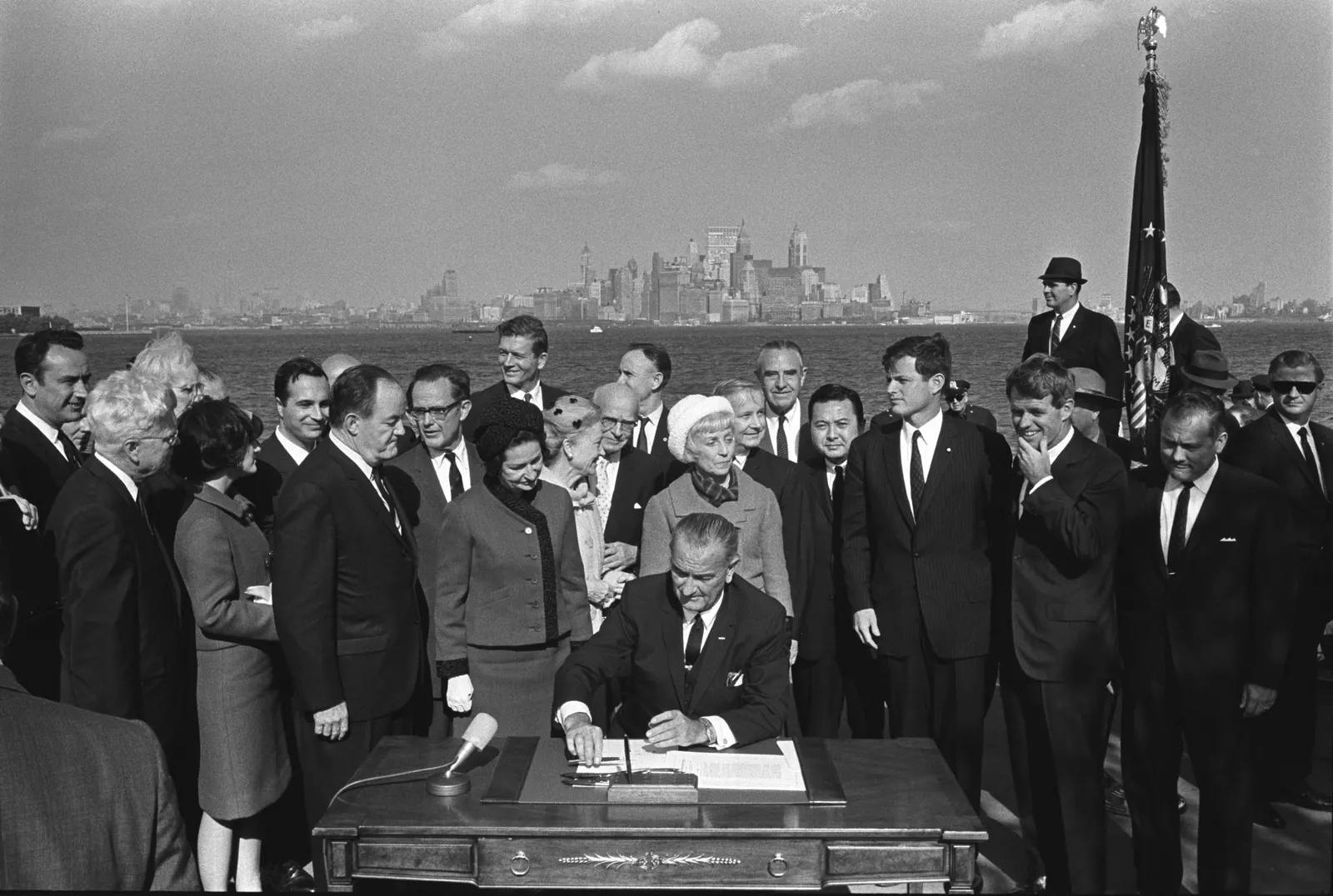
Five days after the speech, on October 3, 1965, Lyndon B. Johnson signed at the foot of the Statue of Liberty the law that abolished the national-origins quota system, the Immigration and Nationality Act of 1965 (H.R. 2580, Public Law 89-236). The ceremony had been scheduled beforehand2, but the president added a section headed "Asylum for Cuban Refugees":
"I declare this afternoon to the people of Cuba that those who seek refuge here in America will find it." Lyndon B. Johnson, Liberty Island, New York, October 3, 19654
Johnson ordered the Departments of State, Justice, and Health, Education, and Welfare (HEW) to make the arrangements for "an orderly entry" of Cubans seeking freedom. He set two priorities: first, those separated from children, parents or spouses already living in the U.S.; then, political prisoners. He announced that he would ask Congress for an additional $12.6 million, directed the State Department to seek, through the Swiss government, Cuba's agreement for the International Committee of the Red Cross to help organize the transfer, and designated Miami as the port of entry and place of transit4.
The law Johnson signed that day would also have direct consequences for Cubans already living in the U.S. without permanent residence: it is at the origin of the Cuban Adjustment Act, told in the next chapter.
The talks went through the Swiss Embassy in Havana2, because Washington had broken diplomatic relations with Cuba on January 3, 19613. On October 13 the Cuban government answered the American proposal: it wanted 12,000 people a month to leave, against the 3,000 Washington was asking for; it would not let men of military age, 15 to 26, go; it accepted priority for immediate relatives; and it wanted to prepare the departure lists itself, though it recognized the U.S. right to veto names. It also did not want the Red Cross involved: the Swiss, it said, were enough2.
The port of Camarioca
While the diplomats argued, the exiles in Florida did not wait. A disorderly rush of small boats from Florida toward Camarioca followed2. The first boats with refugees reached Florida on October 7, and by October 18 more than 700 people had arrived4. National security adviser McGeorge Bundy told Johnson on October 14 that the government had taken "special measures" to persuade Cubans in southern Florida to wait until orderly arrangements could be worked out, and that it had been largely successful2.
Washington insisted that traffic through Camarioca had to be reduced and eliminated. On October 28 the Cuban Ministry of the Interior announced that from that midnight no more boats could dock there to pick up relatives; some 300 boats already anchored kept leaving for the north. On November 4, with the agreement about to be closed, Cuba banned all new departures from Camarioca from noon2.
About 2,000 people were left in the port waiting for a boat. Between November 13 and 24, the U.S. government evacuated them on chartered vessels2. The Immigration and Naturalization Service (INS) summed up those weeks this way: before the negotiations only a small number of refugees had managed to reach the U.S. that fiscal year, but "almost 5,000 refugees arrived by boat while the negotiations were being carried out"5. The University of Miami gives "nearly 5,000" for the two months of the episode6. A Coast Guard historical document counts 2,979 people: "A total of 2,979 Cubans took advantage of Castro's offer during the time the port remained open," adding that the migrants still at the port, "numbering in the thousands," were later taken to Florida on officially chartered passenger vessels7. If those 2,979 are added to the roughly 2,000 evacuees cited by the State Department, the result comes close to the INS figure of almost 5,000, although that sum is this site's own calculation and does not appear in any of the sources.
The Memorandum of Understanding
On November 6, 1965, the Swiss Embassy in Havana and the Cuban Ministry of Foreign Relations exchanged diplomatic notes setting out the procedure for transferring refugees. From Austin, Texas, Johnson had a short statement read out: "I am pleased with the understanding which has been reached. It is an important forward step in carrying out the declaration I made on October 3 to the Cuban people. I said that those who seek refuge here will find it. That continues to be the policy of the American people"8.
The Memorandum of Understanding provided for the departure of 3,000 to 4,000 people a month, on flights paid for by the U.S. government from the Varadero airport, about 85 miles (some 137 kilometers) east of Havana, and it had no expiration date. Cuba wanted to include two exceptions in the text, men of military age and technicians and professionals; Washington refused, and Havana ended up mentioning in supplementary notes its ban on departures by men of military age, certain technicians and political prisoners2.
The lists were organized by category. Category A covered the immediate relatives of people already living in the U.S.; category B, everyone else. By the end of May 1966, almost 22,000 people in category A had arrived; the Cuban government then claimed that no one else in that group wanted to leave, when HEW had close to 50,000 applications in that category9.
Varadero-Miami: two flights a day
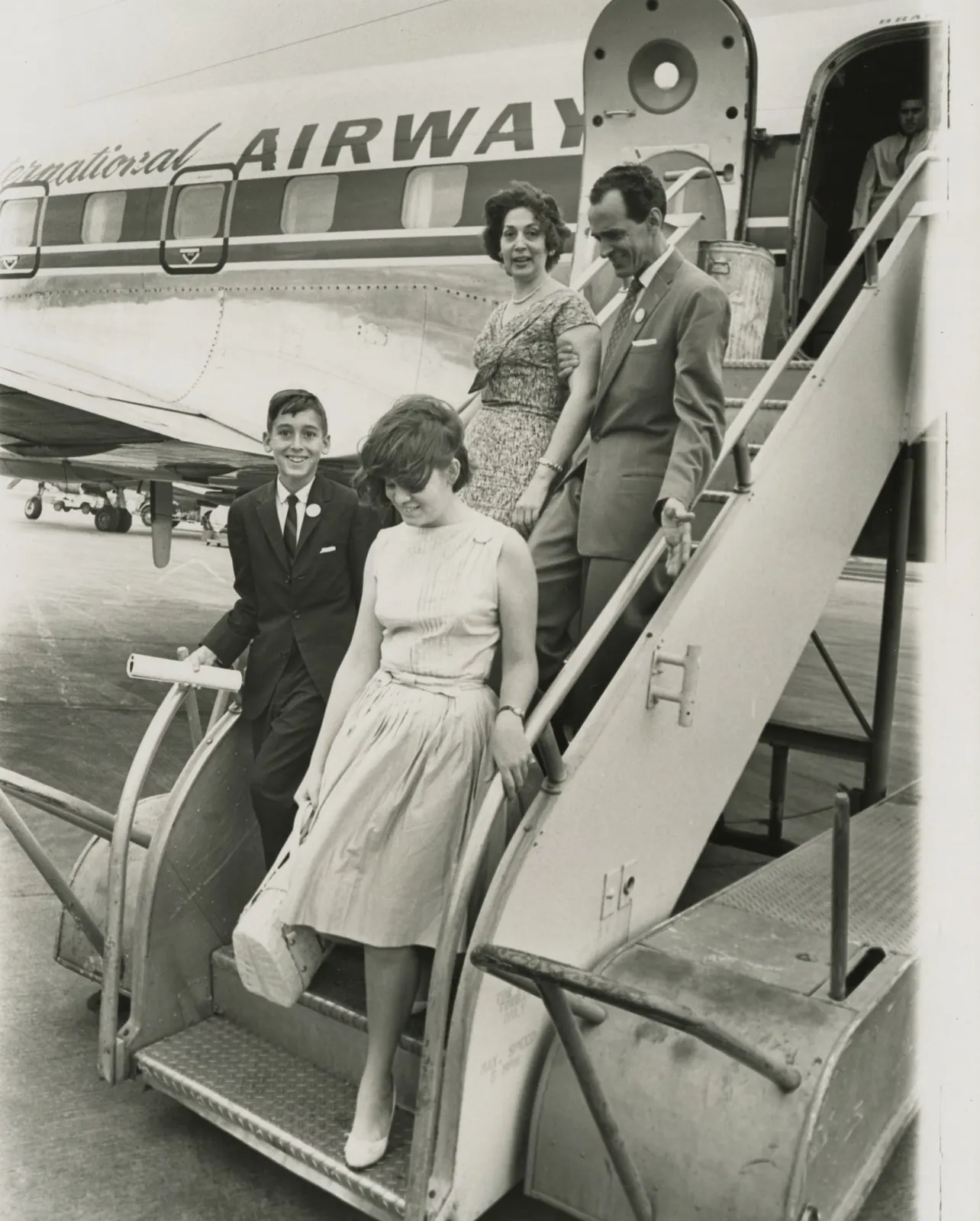
The first flight left Varadero on December 1, 1965. From then on the operation ran two flights a day, five days a week, averaging about 4,000 people a month2. The INS described the same pace years later, except when weather conditions "or other problems" caused a temporary suspension10. A student correspondent who traveled to Havana in 1967 described it from the other side: a National Airlines DC-7 leaving twice a day for Miami, and at the door of the former U.S. embassy, groups of 40 to 60 people waiting their turn, many of them for more than two years11.
Demand quickly overwhelmed the system. The Cuban government stopped accepting new registrations in May 19662, by which time some 250,000 people had signed up, according to an interagency study prepared in 1969 for the U.S. National Security Council12. In December 1968 thousands were still on the list2.
Airlift arrivals, according to the INS annual reports (fiscal years, which ended on June 30), were as follows:
| Fiscal year | Airlift arrivals |
|---|---|
| 1966 (from December 1965) | about 26,000 |
| 1967 | 44,337 |
| 1968 | 44,304 |
| 1969 | 41,751 |
| 1970 | 41,346 |
| 1971 | 43,135 |
| 1972 | 17,109 |
| 1973 (through April) | 4,294 |
Sources: INS, annual reports for 1966 through 19735 13 14 10 15 16 17 18.
Who could leave, and at what price
Leaving did not depend only on being on the list. Men of military age were excluded from the start, and in the last years most of the passengers were elderly or sick, according to a report prepared in 1977 for Secretary of State Cyrus Vance19. The 1967 account added that technicians could not leave either, and that the restriction on young men also held back many parents who did not want to leave their sons behind11.
The price was high. Johnson summed it up in November 1966, when he waived a $25 immigration fee for refugees: "Cuba requires that the refugees coming to this country turn over to the Cuban Government any worldly assets they own before leaving the country"20. Anyone who worked for the state and asked to leave lost the job, according to the 1967 account11. An applicant who left a written account of his wait in 1968 says that people hoping to emigrate were offered two kinds of work, construction or cutting sugarcane in camps away from the cities, and that the police gave out applications whose fine print read: "I accept the State's job offer on my own free will. However, it is understood that if I refuse to comply, by doing so, I give up my 'right' to leave the country"21.
For people with money there were shortcuts. A September 1969 U.S. intelligence estimate observed that many bought tickets to Madrid or Mexico City instead of waiting for the airlift, and estimated that some 200,000 people remained on the waiting list22.
The Freedom Tower
On landing in Miami, the federal Cuban Refugee Program worked at three points: the Freedom Gate, at the airport, where customs and immigration were handled; Freedom House, a temporary shelter nearby; and the Cuban Refugee Center, in the downtown Miami building that came to be known as the Freedom Tower. For Cubans the building was simply "el refugio" ("the refuge")23.
HEW had opened an emergency center for Cuban refugees in Miami in February 1961. Its Commissioner of Welfare, Ellen Winston, told Congress in August 1966 that the airlift had brought 30,487 people through August 5 of that year, of whom 20,322 had already been resettled elsewhere in the country, and that 73 percent of those arriving by air left the Miami area, sometimes within hours24. Resettlement worked through four national voluntary agencies, which Winston listed as the National Catholic Welfare Conference, Church World Service, the International Rescue Committee and the United Hebrew Immigrant Aid Society Service24. The University of Miami identifies the Catholic agency as Catholic Relief Services25.
The cost was considerable. In 1969, the U.S. government calculated that the Cuban Refugee Program had spent more than $300 million since 1961 to assist 317,000 refugees12.
The end
The pace held until 1971, when Cuba tightened its emigration policy26. That same year, before the announcement, Senator Allen Ellender had proposed eliminating funding for the airlift, and the Nixon administration successfully opposed it26. In late August, through the Swiss Embassy, the Cuban government said it was suspending the flights from September 1, 1971 for about two weeks to prepare a final list of around 1,000 names, that it would send no more names, and that, except for humanitarian cases, it would not accept the list of relatives Washington had proposed, among them the parents of some 2,000 Cuban children already in the U.S. The State Department announced it on August 31 and made clear that the decision was Cuba's alone26.
The flights continued intermittently. According to the INS, in September 1971 Cuba declared the list of people entitled to the airlift exhausted and from then on suspended it periodically; in fiscal year 1972, 17,109 people arrived that way and 3,807 through other countries, such as Spain or Mexico, and when that fiscal year closed the flights had been suspended since May17. The last Freedom Flight landed in Miami on April 6, 1973. In fiscal year 1973, 4,294 refugees arrived by air and 5,107 by other means18.
How many people arrived in all? A research memorandum from the State Department's Office of the Historian puts the figure at 260,7372. The University of Miami speaks of "nearly 270,000"6, and the 1977 report prepared for Secretary Vance of "almost 300,000"19. The sources do not explain their differences, which probably depend on what is counted (only airlift passengers, or also those who left by other routes in those years) and on the cutoff date; the prudent course is to say between 260,000 and almost 300,000 people, depending on the source.
After the last flight, legal departure for the U.S. came to depend on third countries, such as Spain or Mexico17. What followed, from the close of 1973 to the reunion of 1979, is told in Dialogue and Reunion (1973-1979).
Notes and sources
-
Fidel Castro Ruz, "Discurso pronunciado [...] resumiendo los actos del V aniversario de los Comités de Defensa de la Revolución, en la concentración efectuada en la Plaza de la Revolución, el 28 de septiembre de 1965" [Speech summing up the events of the fifth anniversary of the Committees for the Defense of the Revolution, at the rally held in the Plaza of the Revolution, September 28, 1965], Departamento de Versiones Taquigráficas del Gobierno Revolucionario, accessed November 11, 2026. Quotations translated from Spanish. http://www.cuba.cu/gobierno/discursos/1965/esp/f280965e.html back back
-
U.S. Department of State, Office of the Historian, Foreign Relations of the United States, 1964-1968, vol. XXXII, document 308, "Editorial Note" (includes the memoranda from McGeorge Bundy of October 6 and 14, 1965 and the total figure from Research Memorandum No. 1230, May 20, 1980). https://history.state.gov/historicaldocuments/frus1964-68v32/d308 back back back back back back back back back back back back back back
-
Congressional Record, vol. 112, part 17, September 19, 1966, p. 22914 (remarks of Representative Michael A. Feighan). https://www.govinfo.gov/content/pkg/GPO-CRECB-1966-pt17/pdf/GPO-CRECB-1966-pt17-5-1.pdf back back
-
Lyndon B. Johnson, "Remarks at the Signing of the Immigration Bill, Liberty Island, New York," October 3, 1965, The American Presidency Project (UCSB), with an editorial note on the first arrivals by sea. https://www.presidency.ucsb.edu/node/241316 back back back
-
U.S. Department of Justice, Immigration and Naturalization Service, Annual Report of the Immigration and Naturalization Service, fiscal year 1966, section "Cuban Refugees." Digitized copy from the USCIS History Library, hosted on honorfirst.com (third-party site). https://www.honorfirst.com/uploads/4/7/0/8/47087249/1966_ins_annual_report.pdf back back
-
University of Miami Libraries, Cuban Heritage Collection, "Exodus from Cuba," in the digital exhibit In Search of Freedom: Cuban Exiles and the U.S. Cuban Refugee Program, 2011. https://scholar.library.miami.edu/digital/exhibits/show/freedom/exodus back back
-
U.S. Coast Guard, Historian's Office, "The 'Other' Boatlift: Camarioca, Cuba, 1965," published by the Department of Defense (consulted in the Internet Archive copy on November 11, 2026). https://media.defense.gov/2020/Jul/02/2002356759/0/0/0/CAMARIOCA1965.PDF back
-
Lyndon B. Johnson, "Statement by the President on the Agreement Covering Movement of Cuban Refugees to the United States," November 6, 1965, The American Presidency Project (UCSB). https://www.presidency.ucsb.edu/node/241090 back
-
Foreign Relations of the United States, 1964-1968, vol. XXXII, document 309, memorandum from Walt Rostow to President Johnson, May 25, 1966. https://history.state.gov/historicaldocuments/frus1964-68v32/d309 back
-
Immigration and Naturalization Service, Annual Report, fiscal year 1969, section "Cuban Refugees." Digitized copy from the USCIS History Library, hosted on honorfirst.com (third-party site). https://www.honorfirst.com/uploads/4/7/0/8/47087249/1969_ins_annual_report.pdf back back
-
Thomas B. Reston, "Cuba's Refugees," The Harvard Crimson, December 18, 1967. https://www.thecrimson.com/article/1967/12/18/cubas-refugees-pthe-old-american-embassy/ back back back
-
Foreign Relations of the United States, 1969-1976, vol. E-10, document 205, study in response to National Security Study Memorandum 32 on Cuba, July 2, 1969. https://history.state.gov/historicaldocuments/frus1969-76ve10/d205 back back
-
Immigration and Naturalization Service, Annual Report, fiscal year 1967, section "Cuban Refugees." Digitized copy from the USCIS History Library, hosted on honorfirst.com (third-party site). https://www.honorfirst.com/uploads/4/7/0/8/47087249/1967_ins_annual_report.pdf back
-
Immigration and Naturalization Service, Annual Report, fiscal year 1968, section "Cuban Refugees." Digitized copy from the USCIS History Library, hosted on honorfirst.com (third-party site). https://www.honorfirst.com/uploads/4/7/0/8/47087249/1968_ins_annual_report.pdf back
-
Immigration and Naturalization Service, 1970 Annual Report, section "Cuban Refugees." Digitized copy from the USCIS History Library, hosted on honorfirst.com (third-party site). https://www.honorfirst.com/uploads/4/7/0/8/47087249/1970_ins_annual_report.pdf back
-
Immigration and Naturalization Service, Annual Report, fiscal year 1971, section "Cuban Refugees." Digitized copy from the USCIS History Library, hosted on honorfirst.com (third-party site). https://www.honorfirst.com/uploads/4/7/0/8/47087249/1971_ins_annual_report.pdf back
-
Immigration and Naturalization Service, Annual Report, fiscal year 1972, section "Cuban Refugees." Digitized copy from the USCIS History Library, hosted on honorfirst.com (third-party site). https://www.honorfirst.com/uploads/4/7/0/8/47087249/1972_ins_annual_report.pdf back back back
-
Immigration and Naturalization Service, Annual Report, fiscal year 1973, section "Cuban Refugees." Digitized copy from the USCIS History Library, hosted on honorfirst.com (third-party site). https://www.honorfirst.com/uploads/4/7/0/8/47087249/1973_ins_annual_report.pdf back back
-
Foreign Relations of the United States, 1977-1980, vol. XXIII, document 4, memorandum from Terence Todman to Secretary of State Cyrus Vance, February 22, 1977. https://history.state.gov/historicaldocuments/frus1977-80v23/d4 back back
-
Lyndon B. Johnson, "Statement by the President Upon Directing the Waiver of Permanent Resident Application Fees for Cuban Refugees," November 10, 1966, The American Presidency Project (UCSB). https://www.presidency.ucsb.edu/node/238423 back
-
Ralph Rewes, "The Dreadful Procedure of Leaving Cuba Legally" (personal account from 1968, published online), accessed November 11, 2026. https://amigospais-guaracabuya.org/oagrr003.php back
-
Foreign Relations of the United States, 1969-1976, vol. E-10, document 207, National Intelligence Estimate 85-69, September 2, 1969. https://history.state.gov/historicaldocuments/frus1969-76ve10/d207 back
-
University of Miami Libraries, "Arrival in Florida," in In Search of Freedom: Cuban Exiles and the U.S. Cuban Refugee Program, 2011. https://scholar.library.miami.edu/digital/exhibits/show/freedom/arrival back
-
U.S. House of Representatives, Committee on the Judiciary, Subcommittee No. 1, Adjustment of Status for Cuban Refugees: Hearings on H.R. 15182, H.R. 15183, H.R. 16908, H.R. 10808 and H.R. 13393, 89th Congress, 2nd Session, August 10, 11 and 17, 1966, testimony of Ellen Winston, pp. 50-51 and 59. https://www.govinfo.gov/content/pkg/CHRG-89hhrg67905/pdf/CHRG-89hhrg67905.pdf back back
-
University of Miami Libraries, "Resettlement," in In Search of Freedom: Cuban Exiles and the U.S. Cuban Refugee Program, 2011. https://scholar.library.miami.edu/digital/exhibits/show/freedom/resettlement back
-
Foreign Relations of the United States, 1969-1976, vol. E-10, document 243, memorandum from Henry Kissinger to President Nixon, "Termination of Cuban Refugee Airlift," September 2, 1971. https://history.state.gov/historicaldocuments/frus1969-76ve10/d243 back back back