1966
The Birth of the Cuban Adjustment Act
How Congress pulled paroled refugees out of legal limbo
On November 2, 1966, Lyndon B. Johnson signed a one-page law with a descriptive title: "An Act to adjust the status of Cuban refugees to that of lawful permanent residents of the United States, and for other purposes"1. Eight days later the White House estimated that some 123,000 people could apply for residence immediately, and that about 4,000 more would be added each month as long as people kept arriving at that rate2. Public Law 89-732, known ever since as the Cuban Adjustment Act, was not born as a grand declaration of principle but as the practical fix for a specific problem: hundreds of thousands of Cubans lived in the United States unable to become residents unless they left the country and came back in.
The limbo of parole
As long as there were U.S. consulates in Cuba, many Cubans emigrated on immigrant visas and arrived as residents. That route closed on January 3, 1961, when Washington broke diplomatic relations with Havana. After that, most entered under a visa waiver mechanism agreed between the State Department and the Attorney General, and remained, in the words of Representative Michael A. Feighan, "in a status other than that of permanent residence"3.
The 1966 numbers showed the scale of the problem. Before Congress, Under Secretary of State George Ball explained that since January 1, 1959 some 75,000 Cubans had been admitted as permanent residents on immigrant visas, while on June 30, 1966 there were 115,101 Cubans in the country on parole and another 47,080 on voluntary departure4. Parole was a discretionary authorization from the Attorney General to remain in the country without an immigrant visa5. It allowed a person to stay, but it was not permanent residence and did not count as time of residence toward naturalization4.
Why could they not become residents from inside the country? Because of section 245 of the Immigration and Nationality Act (INA), which governs adjustment of status. Since a 1958 amendment, that section had excluded natives of countries contiguous to the U.S. and of "adjacent islands"4, a legal category that expressly includes Cuba6. The 1965 immigration law, in force from December 1 of that year, extended the exclusion to all natives of the Western Hemisphere, and also postponed until at least July 1, 1968 the effective date of a numerical cap on immigration from that hemisphere4.
One legal exit remained: travel to a U.S. consulate in another country, almost always Canada or Mexico, apply there for the immigrant visa and reenter. Feighan warned that the procedure placed an unduly heavy workload on consular posts in neighboring countries, "particularly in Canada"3. Ball put it more bluntly: "This is not possible for some applicants, either because their employment is such that they can't leave it or because of the fact that they simply don't have the money to make the necessary trip"4. A refugee who arrived with nothing, he added, would have to give up the job that supported his family, pay for the trip and support himself abroad for an uncertain period because of the congestion at the border consulates4.
Senator Philip A. Hart of Michigan summed up the absurdity during the Senate debate:
"It seems almost unbelievable that the only way in which a Cuban professional person, caught in this web, can obtain permanent resident status, is to pack himself and his family over the border to neighboring Canada where he may be processed for a visa granting him permission to return to the country which he just left." Senator Philip A. Hart, October 6, 19665
The lack of residence had concrete costs. Representative William F. Ryan of New York told the House floor that there were at least 1,700 doctors among the refugees, that 41 states required citizenship or permanent residence for a license, and that only about 700 had obtained one. The same was true, he said, of architects, dentists, lawyers, nurses and teachers3. The Justice Department added that permanent residence would allow them to work in their professions and resettle outside Florida, and would reduce federal spending on refugees4.
The bills
The idea was not new. Senator Hart had introduced the first adjustment bill for Cubans in the Senate in February 1962, as Senator Edward M. Kennedy, chairman of the Senate refugee subcommittee, recalled in 19665. In 1965, Senator Jacob K. Javits got the Senate to include a similar amendment in the general immigration reform, but it was lost in the conference committee with the House5. The House Judiciary Committee then judged it premature: no one knew how the departure agreement with Cuba would work and diplomatic implications were feared, so it decided to wait until the State Department stated that the legislation would be "purely for humanitarian and practical reasons" and would "in no way reflect any change in the attitude of the U.S. Government with regard to the present regime in Cuba"3.
On September 1, 1965, a week after the House passed its version of the immigration reform, Ryan introduced H.R. 10808 to adjust the status of Cuban refugees. On May 23, 1966, Jacob H. Gilbert, also of New York and a member of the immigration subcommittee, introduced H.R. 15183, a very similar bill that was the one that prevailed3.
Subcommittee No. 1 of the House Judiciary Committee, chaired by Feighan, held hearings on August 10, 11 and 17, 1966 on H.R. 15183 and four related bills4. Those testifying included Under Secretary of State George Ball, Attorney General Nicholas Katzenbach and the Welfare Commissioner of the Department of Health, Education, and Welfare (HEW), Ellen Winston, among others4 7. In the Senate, the immigration subcommittee heard on August 16 the Assistant Secretary of State for Inter-American Affairs, Lincoln Gordon, and Deputy Attorney General Ramsey Clark on S. 1241 and S. 37127.
The Justice Department expressly supported H.R. 15183 and opposed, by contrast, the bills that opened adjustment of status, in whole or in part, to natives of the other countries of the Western Hemisphere. Its argument was that the Cubans' lack of residence was not the result of any provision of law or policy directed at them but of "the physical impossibility of procuring a visa from a consular officer in Cuba"4. The House Judiciary Committee filed its report, House Report No. 1978, on September 1, 1966; the Senate's, Senate Report No. 1675 on S. 3712, on October 47.
The House vote
On September 19, 1966, Feighan asked the House to suspend the rules and pass H.R. 15183, a procedure that limits debate and requires a two-thirds majority. The House version was simpler than the final law: it allowed adjustment of any native or citizen of Cuba admitted or paroled after January 1, 1959, with no minimum length of stay, and dated the residence from the day the application was approved3.
There were doubts about security. Representative Haley of Florida asked what check there was on the boats arriving at night in the Florida inlets. Feighan answered that refugees were checked against the so-called Caribbean index, a compilation of information from the U.S. intelligence community, and that people arriving by boat usually turned themselves in because they needed help; Haley replied that he was afraid the chairman was "a little optimistic"3.
When the Speaker announced that two thirds had voted in favor, Representative Clark MacGregor of Minnesota objected on the ground that a quorum was not present and forced a roll call. The result was 300 votes in favor and 25 against, with 107 members not voting (Roll No. 288)3.
The Senate and the conference
On October 6, 1966, the Senate debated S. 3712, which the Judiciary Committee had rewritten entirely. Its version added two conditions and one novelty: it required the refugee to have been in the U.S. at least two years, dated the residence from the day of his last arrival in the country, and extended the benefit to Dominicans displaced by the civil war between April 24, 1965 and June 2, 1966. It also incorporated the content of H.R. 12596, already passed by the House, to save the pending adjustment applications of people from the Western Hemisphere as of December 1, 19655.
Kennedy recalled that the airlift had brought more than 36,500 Cubans since December 1, 1965 and that the refugee program would cost almost $51 million that fiscal year5. Senator Sam J. Ervin of North Carolina, who said "I am a stanch advocate of restricted immigration," supported the bill because the refugees had no prospect of returning to their country and the situation was, in the words of Grover Cleveland, "a condition and not a theory"5. After S. 3712 was passed, Majority Leader Mike Mansfield asked that the Senate take up H.R. 15183, substitute the text of S. 3712 for it and pass it. That was done, without a roll call5.
The House rejected the Senate amendments on October 7 and asked for a conference committee; the Senate insisted on October 137. The conferees were, for the House, Emanuel Celler, Feighan, Gilbert, William M. McCulloch and Arch A. Moore Jr., and for the Senate, John L. McClellan, Ervin, Kennedy, Everett M. Dirksen and Hiram L. Fong8.
The conference report (House Report No. 2334) adopted the Senate text, with changes. The Dominicans were dropped. The House requirement of arrival after January 1, 1959 and the Senate requirement of two years of physical presence were kept. And on the most disputed point, the date of the residence, a middle formula was agreed: 30 months before the application or the date of last arrival, whichever was later8. Gilbert explained on the floor that most of the refugees had been in the country for years and that the conferees thought it only equitable to give them "some retroactive status as permanent residents, but not going so far as to make them automatically eligible to apply for naturalization"8.
Not everyone was enthusiastic. Moore, of West Virginia, urged adoption of the conference report "with some reluctance": he feared it would be read as acceptance of the Castro government and complained that the executive branch had reported no progress in securing the release of the 800 or more U.S. citizens who, he said, remained in Cuba8. The Senate approved the conference report on October 20 and the House on October 21, clearing the bill for the president's signature7.
The signing
Johnson signed on November 2, 1966. The law was recorded as Public Law 89-732 and published in volume 80 of the Statutes at Large, page 11611. On November 10, from San Antonio, the president returned to it in a statement: "On November 2, I signed into law legislation which authorizes adjustment of the status of Cuban refugees. This means that refugees who have been in this country for 2 years or more can become permanent U.S. residents." In the same statement he ordered the Attorney General to waive the $25 fee for the procedure, because "Cuba requires that the refugees coming to this country turn over to the Cuban Government any worldly assets they own before leaving the country," and stressed that residence would let them seek professional licenses and begin the process of becoming eligible for citizenship2.
What the law said
The original text had four sections. The first is the one that gave the law its name. It begins "That, notwithstanding the provisions of section 245(c) of the Immigration and Nationality Act," that is, despite the bar on adjusting natives of the Western Hemisphere, and allows the Attorney General, "in his discretion and under such regulations as he may prescribe," to adjust to permanent resident status "any alien who is a native or citizen of Cuba"1 who meets these conditions:
- has been "inspected and admitted or paroled into the United States subsequent to January 1, 1959";
- has been "physically present in the United States for at least two years";
- applies for the adjustment, and
- is eligible to receive an immigrant visa and is admissible to the United States for permanent residence.
On approving the application, the Attorney General was to create a record of admission for permanent residence "as of a date thirty months prior to the filing of such an application or the date of his last arrival into the United States, whichever date is later." The law also applied to the spouse and child of the beneficiary who lived with him, "regardless of their citizenship and place of birth"1.
Section 2 allowed Cubans who had already become residents through consulates abroad to move their residence date back to their original arrival, with a limit of 30 months before the enactment of the law. Section 3 was the savings clause of H.R. 12596 for Western Hemisphere adjustment applications filed before December 1, 1965, and section 4 referred to the INA definitions and preserved the Attorney General's powers1. The full text, with its amendments, is in Text of the Act.
The first years
The Immigration and Naturalization Service (INS) handled the applications at a Cuban Adjustment Center in Miami9. At the close of fiscal year 1967, on June 30, it had received 41,052 applications and 25,752 Cubans were already permanent residents; another 1,562 who were already residents had moved their residence date back under section 2, and 1,882 people from other countries of the hemisphere benefited from section 39.
The following year was the flood. In fiscal year 1968 applications doubled and 95,679 cases were resolved, partly because many Cubans rushed to file in May and June 1968 to avoid the cap of 120,000 annual Western Hemisphere visas, which took effect on July 110. The INS summed it up in its report the next year: most adjustments were concentrated in fiscal year 1968, when more than 90,000 Cubans obtained residence before the cap took effect11. From July 1, 1968, Cubans adjusting competed for those numbers with the rest of the hemisphere, and their residence was not recorded until a visa was available; in June 1970 numbers were being assigned to those with priority dates earlier than April 22, 196912.
| Fiscal year | Cubans recorded as residents under the 1966 law | Counted against the hemisphere cap |
|---|---|---|
| 1967 | 25,752 | no |
| 1968 | 91,520 | no |
| 1969 | 6,343 | yes |
| 1970 | 12,208 | yes |
Source: INS, 1970 Annual Report, table 412.
From November 2, 1966 to June 30, 1970, the INS received 170,678 applications for adjustment from Cuban refugees, approved 140,582 and denied 1,76312. By mid-1972 the cumulative number of adjustments reached 174,81913.
That cap lasted until the 1976 immigration reform (Public Law 94-571), whose section 8 provided that adjustments of Cubans who were in the country when the reform took effect, on January 1, 1977, would not subtract visas from any category; the Refugee Act of 1980 later reduced the required physical presence from two years to one14. In fiscal year 1977, the year the reform took effect, 71,440 adjustments of Cubans were approved, compared with 27,891 in 197815. Those reforms are told in Amendments and Related Laws.
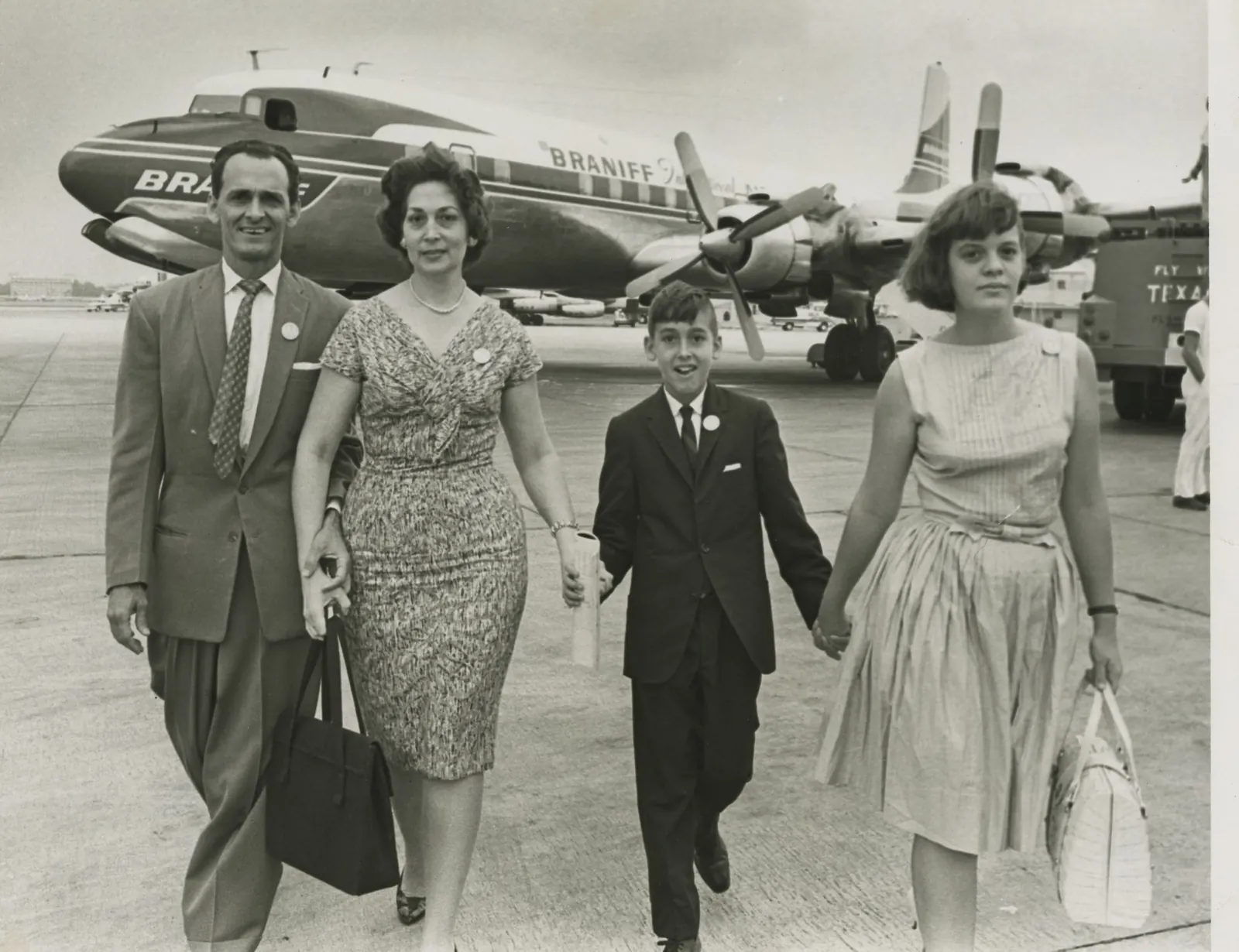
Meanwhile, the airlift kept bringing refugees from Varadero, as told in Camarioca and the Freedom Flights. Those who arrived that way entered on parole13 and, after two years in the country, could take advantage of the new law.
Notes and sources
-
An Act to adjust the status of Cuban refugees to that of lawful permanent residents of the United States, and for other purposes, Public Law 89-732 (H.R. 15183), November 2, 1966, 80 Stat. 1161. https://www.govinfo.gov/content/pkg/STATUTE-80/pdf/STATUTE-80-Pg1161.pdf back back back back back
-
Lyndon B. Johnson, "Statement by the President Upon Directing the Waiver of Permanent Resident Application Fees for Cuban Refugees," November 10, 1966, The American Presidency Project (UCSB). https://www.presidency.ucsb.edu/node/238423 back back
-
Congressional Record, vol. 112, part 17, September 19, 1966, pp. 22913-22922 (debate and vote on H.R. 15183; remarks of Michael A. Feighan, William F. Ryan, Jacob H. Gilbert and Representative Haley of Florida, among others). https://www.govinfo.gov/content/pkg/GPO-CRECB-1966-pt17/pdf/GPO-CRECB-1966-pt17-5-1.pdf back back back back back back back back
-
U.S. House of Representatives, Committee on the Judiciary, Subcommittee No. 1, Adjustment of Status for Cuban Refugees: Hearings on H.R. 15182, H.R. 15183, H.R. 16908, H.R. 10808 and H.R. 13393, 89th Congress, 2nd Session, August 10, 11 and 17, 1966, Serial No. 20, pp. 5, 7-10 and 17 (statement of George W. Ball and Department of Justice report). https://www.govinfo.gov/content/pkg/CHRG-89hhrg67905/pdf/CHRG-89hhrg67905.pdf back back back back back back back back back back
-
Congressional Record, vol. 112, part 19, October 6, 1966, pp. 25466-25468 (debate on S. 3712 and Senate passage of H.R. 15183; remarks of Edward M. Kennedy, Philip A. Hart, Jacob K. Javits, Sam J. Ervin and Mike Mansfield). https://www.govinfo.gov/content/pkg/GPO-CRECB-1966-pt19/pdf/GPO-CRECB-1966-pt19-2-1.pdf back back back back back back back back
-
8 U.S.C. § 1101(b)(5), definition of "adjacent islands," Legal Information Institute, Cornell Law School. https://www.law.cornell.edu/uscode/text/8/1101 back
-
Congressional Record, vol. 112, part 23, 1966 Daily Digest, entries for August 10, 11, 16 and 17, September 1 and 19, and October 4, 6, 7, 13, 19, 20 and 21, 1966, and the table of bill histories for measures passed (H.R. 15183). https://www.govinfo.gov/content/pkg/GPO-CRECB-1966-pt23/pdf/GPO-CRECB-1966-pt23-1-13.pdf back back back back back
-
Congressional Record, vol. 112, part 21, October 21, 1966, pp. 28605-28609 (conference report H. Rept. No. 2334, statement of the House managers and remarks of Gilbert, Moore and Feighan). https://www.govinfo.gov/content/pkg/GPO-CRECB-1966-pt21/pdf/GPO-CRECB-1966-pt21-2-2.pdf back back back back
-
U.S. Department of Justice, Immigration and Naturalization Service, Annual Report of the Immigration and Naturalization Service, fiscal year 1967, section "Cuban Refugees." Digitized copy from the USCIS History Library, hosted on honorfirst.com (third-party site). https://www.honorfirst.com/uploads/4/7/0/8/47087249/1967_ins_annual_report.pdf back back
-
Immigration and Naturalization Service, Annual Report, fiscal year 1968, section "Cuban Adjustment." Digitized copy from the USCIS History Library, hosted on honorfirst.com (third-party site). https://www.honorfirst.com/uploads/4/7/0/8/47087249/1968_ins_annual_report.pdf back
-
Immigration and Naturalization Service, Annual Report, fiscal year 1969, sections "Cuban Refugees" and "Cuban Adjustments." Digitized copy from the USCIS History Library, hosted on honorfirst.com (third-party site). https://www.honorfirst.com/uploads/4/7/0/8/47087249/1969_ins_annual_report.pdf back
-
Immigration and Naturalization Service, 1970 Annual Report, section "Cuban Adjustments" and table 4. Digitized copy from the USCIS History Library, hosted on honorfirst.com (third-party site). https://www.honorfirst.com/uploads/4/7/0/8/47087249/1970_ins_annual_report.pdf back back back
-
Immigration and Naturalization Service, Annual Report, fiscal year 1972, section "Cuban Refugees." Digitized copy from the USCIS History Library, hosted on honorfirst.com (third-party site). https://www.honorfirst.com/uploads/4/7/0/8/47087249/1972_ins_annual_report.pdf back back
-
Public Law 94-571, October 20, 1976, sections 8 and 10, 90 Stat. 2703, 2706-2707, https://www.govinfo.gov/content/pkg/STATUTE-90/pdf/STATUTE-90-Pg2703.pdf; Public Law 96-212 (Refugee Act of 1980), section 203(i), 94 Stat. 102, 108, https://www.govinfo.gov/content/pkg/STATUTE-94/pdf/STATUTE-94-Pg102.pdf; and Congressional Research Service, Cuban Migration to the United States: Policy and Trends, report R40566, June 2, 2009, p. 2, note 6. https://www.everycrsreport.com/files/20090602_R40566_5c818df5cf6f61aac828f7e487dfe38f29f6dce4.pdf back
-
Immigration and Naturalization Service, Annual Report, fiscal year 1978, section "Cuban Adjustments" (with the effective date of the 1976 reforms). Digitized copy from the USCIS History Library, hosted on honorfirst.com (third-party site). https://www.honorfirst.com/uploads/4/7/0/8/47087249/1978_ins_annual_report.pdf back