Text
The Text of the Cuban Adjustment Act
The 1966 law word for word, the current text, and what changed between the two
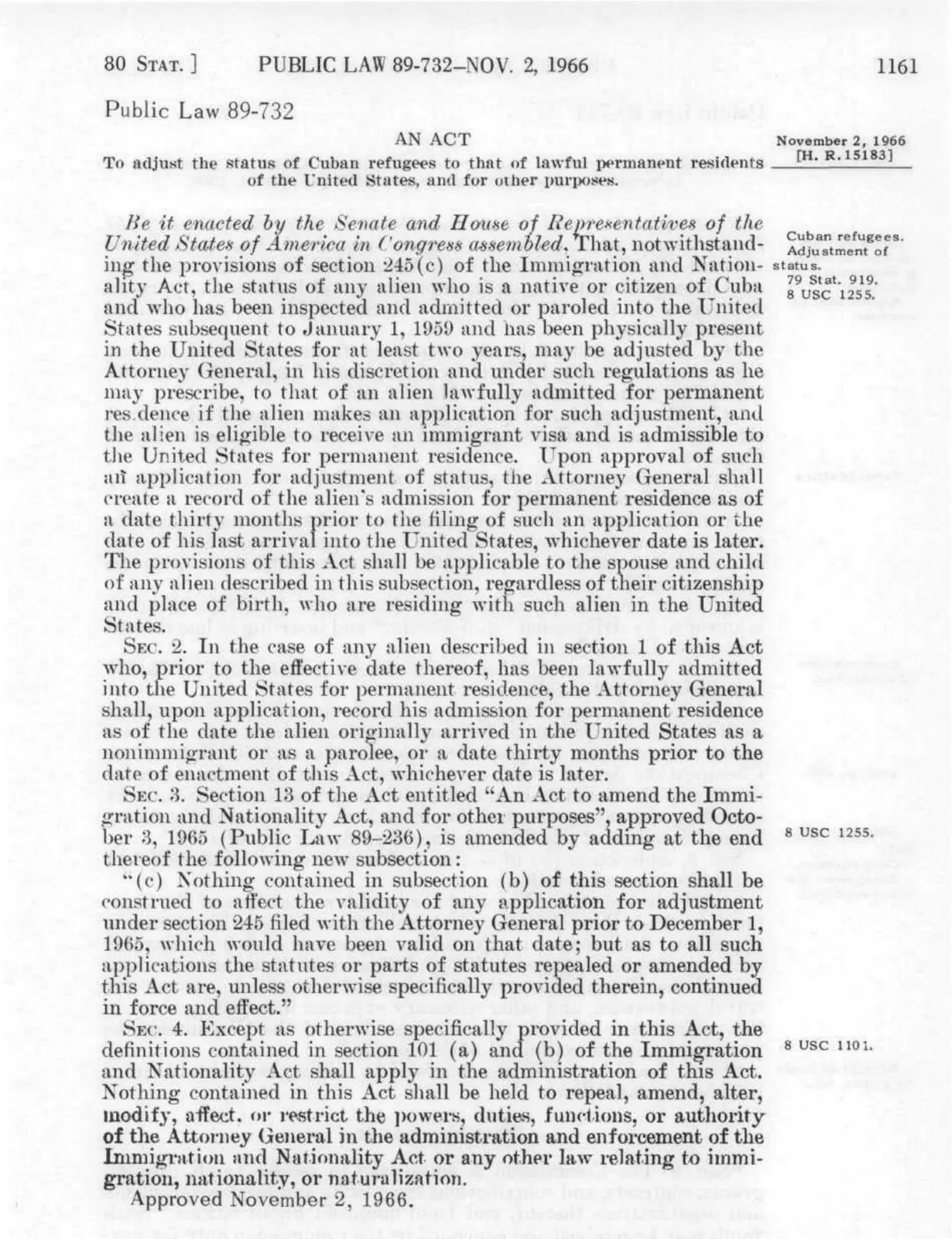
The Cuban Adjustment Act fits on a single page. In volume 80 of the Statutes at Large, the official collection of acts of Congress, it takes up the whole of page 1161: a title, four sections, and the date of enactment, November 2, 19661. Its official name is not "Cuban Adjustment Act," which is only the popular name, but "An Act to adjust the status of Cuban refugees to that of lawful permanent residents of the United States, and for other purposes." Sixty years later it is still in force, now with five sections: four later laws amended it and a fifth set the conditions for its repeal2.
This page reproduces both texts: the original, as it left Congress, and the current one, as the Office of the Law Revision Counsel of the House of Representatives now publishes it in its edition of the United States Code. Below each section is a plain-language commentary. To understand how the law is applied today, the page How it works explains the requirements; the history of each amendment is in Amendments and related laws.
How to read this page
- The texts. They are literal transcriptions of the official sources: the facsimile of the Statutes at Large published by the Government Publishing Office (GPO) at govinfo.gov1 and the note to 8 U.S.C. § 1255 at uscode.house.gov, updated through Public Law 119-138 of November 3, 20262. The current text matches the 2024 edition of the Code published on govinfo3. Only typographic details have been normalized: curly quotation marks are written straight, words hyphenated at the end of a line in the facsimile are written whole, and typographic dashes are transcribed as ordinary hyphens or double hyphens (--), as in the GPO's plain-text editions.
- Brackets. In the current text, anything in brackets is not part of the law: these are editorial clarifications by the Office of the Law Revision Counsel, kept because they are part of the official publication.
- The word "alien." It is the legal term of the era and of the current Code, and it appears in the texts below exactly as written there.
The original 1966 text
Heading
Public Law 89-732
AN ACT
To adjust the status of Cuban refugees to that of lawful permanent residents of the United States, and for other purposes.
Be it enacted by the Senate and House of Representatives of the United States of America in Congress assembled,
Commentary. The word "refugees" appears only in the title. The body of the law never uses it: it speaks of any alien "who is a native or citizen of Cuba." The heading of the facsimile identifies the bill of origin, H.R. 15183 of the House of Representatives1.
Section 1
That, notwithstanding the provisions of section 245(c) of the Immigration and Nationality Act, the status of any alien who is a native or citizen of Cuba and who has been inspected and admitted or paroled into the United States subsequent to January 1, 1959 and has been physically present in the United States for at least two years, may be adjusted by the Attorney General, in his discretion and under such regulations as he may prescribe, to that of an alien lawfully admitted for permanent residence if the alien makes an application for such adjustment, and the alien is eligible to receive an immigrant visa and is admissible to the United States for permanent residence. Upon approval of such an application for adjustment of status, the Attorney General shall create a record of the alien's admission for permanent residence as of a date thirty months prior to the filing of such an application or the date of his last arrival into the United States, whichever date is later. The provisions of this Act shall be applicable to the spouse and child of any alien described in this subsection, regardless of their citizenship and place of birth, who are residing with such alien in the United States.
Commentary. This is the central section of the law and contains almost everything that matters:
- "Notwithstanding the provisions of section 245(c)." Section 245 of the Immigration and Nationality Act (INA) is the general route to becoming a resident without leaving the country. Since 1958, its subsection (c) had excluded from that route natives of the countries contiguous to the United States and of the "adjacent islands"4, a statutory category that expressly names Cuba5. The 1965 reform extended the exclusion to natives of any country in the Western Hemisphere, effective December 1, 19656. The 1966 law opens for Cubans the door that this subsection had closed to them.
- Inspected and admitted or paroled. The entry must have passed through an immigration officer. Parole is the discretionary permission to enter the country that, by statutory definition, does not count as an admission7. The Adjudicator's Field Manual (AFM) of U.S. Citizenship and Immigration Services (USCIS) describes the 1966 beneficiaries this way: mostly "parolees or nonimmigrants who could not return to Cuba for political reasons, but could not seek residence through other means"8.
- Discretion. The law says "may," not "shall." Meeting the requirements does not oblige the government to approve the application.
- The thirty months. Residence does not begin on the day of approval but is dated backward: thirty months before the application or the day of the last arrival, whichever date is later. This is what is known as the rollback. The date has consequences: in its naturalization guidance, USCIS takes the rollback date, not the approval date, as the date of residence of someone who adjusted under this law9.
- Spouse and child of any nationality, as long as they live with the Cuban in the United States. The sentence speaks of "this subsection" although section 1 is not divided into subsections; it is a drafting imperfection that no amendment has corrected.
- The Attorney General appears because in 1966 that official was the authority charged with applying the immigration law, as section 4 itself recalls. Today, under the regulation, USCIS decides applications except in cases where jurisdiction belongs to an immigration judge10.
Section 2
SEC. 2. In the case of any alien described in section 1 of this Act who, prior to the effective date thereof, has been lawfully admitted into the United States for permanent residence, the Attorney General shall, upon application, record his admission for permanent residence as of the date the alien originally arrived in the United States as a nonimmigrant or as a parolee, or a date thirty months prior to the date of enactment of this Act, whichever date is later.
Commentary. This section looks backward. It benefits Cubans who had already become residents before November 2, 1966 by other routes: it lets them ask that their residence be dated from the day they arrived or from May 2, 1964 (thirty months before enactment), whichever is later. The current regulation still governs this application, which is accompanied by the green card so that USCIS can replace it with another bearing the new date10.
Section 3
SEC. 3. Section 13 of the Act entitled "An Act to amend the Immigration and Nationality Act, and for other purposes", approved October 3, 1965 (Public Law 89-236), is amended by adding at the end thereof the following new subsection:
"(c) Nothing contained in subsection (b) of this section shall be construed to affect the validity of any application for adjustment under section 245 filed with the Attorney General prior to December 1, 1965, which would have been valid on that date; but as to all such applications the statutes or parts of statutes repealed or amended by this Act are, unless otherwise specifically provided therein, continued in force and effect."
Commentary. This section is not about Cubans. It corrects a transition problem in the 1965 reform: subsection (b) of its section 13 is precisely the one that extended the exclusion in section 245(c) to the entire Western Hemisphere6. The amendment protects adjustment applications filed before December 1, 1965, the date on which that reform took effect, by people from any country of the hemisphere who at that moment could still use the general route.
Section 4
SEC. 4. Except as otherwise specifically provided in this Act, the definitions contained in section 101 (a) and (b) of the Immigration and Nationality Act shall apply in the administration of this Act. Nothing contained in this Act shall be held to repeal, amend, alter, modify, affect, or restrict the powers, duties, functions, or authority of the Attorney General in the administration and enforcement of the Immigration and Nationality Act or any other law relating to immigration, nationality, or naturalization.
Approved November 2, 1966.
Commentary. The first sentence matters more than it seems: through it, words such as "child" mean in this law the same as in the general immigration law, where "child" is an unmarried person under twenty-one with one of the relationships that law lists (born in wedlock, a stepchild, or an adopted child, among others)5. The second sentence is a closing clause that already appeared, almost word for word, in the 1960 law that opened section 245 to those with parole11.
The current text
The Office of the Law Revision Counsel did not incorporate the Adjustment Act as a section of its own in the Code, but as a note to 8 U.S.C. § 1255 (section 245 of the Immigration and Nationality Act), under the heading "Cuban Refugees: Adjustment of Status." The note begins with the 1996 provision on its repeal and continues with the amended text of the law2. In the quotations that follow, everything in brackets is a note by that Office's editor, not text of the law.
The conditional repeal (1996)
Pub. L. 104-208, div. C, title VI, § 606, Sept. 30, 1996, 110 Stat. 3009-695 provided that:
"(a) In General.--Public Law 89-732 [set out below] is repealed effective only upon a determination by the President under section 203(c)(3) of the Cuban Liberty and Democratic Solidarity (LIBERTAD) Act of 1996 [22 U.S.C. 6063(c)] (Public Law 104-114) that a democratically elected government in Cuba is in power.
"(b) Limitation.--Subsection (a) shall not apply to aliens for whom an application for adjustment of status is pending on such effective date."
Commentary. It is not an amendment to the text but a separate law: section 606 of the Illegal Immigration Reform and Immigrant Responsibility Act (IIRIRA), included in the omnibus appropriations act for fiscal year 199712. It refers to the Helms-Burton law, whose section 206 lists what a Cuban government must meet to be considered "democratically elected": free elections with international observers, respect for civil liberties, progress toward a market economy, progress toward an independent judiciary and toward the return or compensation of property confiscated from U.S. citizens, among other requirements13. That presidential determination has not been made: the law remains in the current Code2.
Current section 1
Pub. L. 89-732, Nov. 2, 1966, 80 Stat. 1161, as amended by Pub. L. 94-571, § 8, Oct. 20, 1976, 90 Stat. 2706; Pub. L. 96-212, title II, § 203(i), Mar. 17, 1980, 94 Stat. 108; Pub. L. 106-386, div. B, title V, § 1509(a), Oct. 28, 2000, 114 Stat. 1530; Pub. L. 109-162, title VIII, § 823(a), Jan. 5, 2006, 119 Stat. 3063, provided:
"That, notwithstanding the provisions of section 245(c) of the Immigration and Nationality Act [subsec. (c) of this section], the status of any alien who is a native or citizen of Cuba and who has been inspected and admitted or paroled into the United States subsequent to January 1, 1959 and has been physically present in the United States for at least one year, may be adjusted by the Attorney General, in his discretion and under such regulations as he may prescribe, to that of an alien lawfully admitted for permanent residence if the alien makes an application for such adjustment, and the alien is eligible to receive an immigrant visa and is admissible to the United States for permanent residence. Upon approval of such an application for adjustment of status, the Attorney General shall create a record of the alien's admission for permanent residence as of a date thirty months prior to the filing of such an application or the date of his last arrival into the United States, whichever date is later. The provisions of this Act shall be applicable to the spouse and child of any alien described in this subsection, regardless of their citizenship and place of birth, who are residing with such alien in the United States, except that such spouse or child who has been battered or subjected to extreme cruelty may adjust to permanent resident status under this Act without demonstrating that he or she is residing with the Cuban spouse or parent in the United States. In acting on applications under this section with respect to spouses or children who have been battered or subjected to extreme cruelty, the Attorney General shall apply the provisions of section 204(a)(1)(J) [probably means section 204(a)(1)(J) of the Immigration and Nationality Act, which is classified to section 1154(a)(1)(J) of this title]. An alien who was the spouse of any Cuban alien described in this section and has resided with such spouse shall continue to be treated as such a spouse for 2 years after the date on which the Cuban alien dies (or, if later, 2 years after the date of enactment of Violence Against Women and Department of Justice Reauthorization Act of 2005) [Jan. 5, 2006], or for 2 years after the date of termination of the marriage (or, if later, 2 years after the date of enactment of Violence Against Women and Department of Justice Reauthorization Act of 2005) if there is demonstrated a connection between the termination of the marriage and the battering or extreme cruelty by the Cuban alien.
Commentary. The first half is identical to 1966 except for one change: "two years" became "one year" with the Refugee Act of 1980, effective immediately before April 1, 198014. The next two sentences, on abused spouses and children, were added in 2000 by that year's Violence Against Women Act; the original cross-reference was to section 204(a)(1)(H), and the 2005 reauthorization corrected it to 204(a)(1)(J), retroactive to 20001516. Section 204(a)(1)(J) is the one that requires considering "any credible evidence" in abuse cases8. The last sentence, from 2006, keeps spousal status for two years after the Cuban's death or after a divorce tied to the abuse16. Read literally, the rule on death does not mention abuse; USCIS, in its manual, applies both rules only to abused spouses and children8. The section 245(c) to which the law still refers is no longer the one from 1966: since the 1976 reform it does not exclude those born in the Western Hemisphere but crewmen, those who worked without authorization or did not maintain lawful status, and other groups2, and USCIS understands that none of those bars applies to the Adjustment Act8.
Current sections 2 through 4
"Sec. 2. In the case of any alien described in section 1 of this Act who prior to the effective date thereof [Nov. 2, 1966], has been lawfully admitted into the United States for permanent residence, the Attorney General shall, upon application, record his admission for permanent residence as of the date the alien originally arrived in the United States as a nonimmigrant or as a parolee, or a date thirty months prior to the date of enactment of this Act [Nov. 2, 1966], whichever date is later.
"Sec. 3. Section 13 of the Act entitled 'An Act to amend the Immigration and Nationality Act, and for other purposes', approved October 3, 1965 (Public Law 89-236) [amending subsecs. (b) and (c) of this section] is amended by adding at the end thereof the following new subsection:
"'(c) Nothing contained in subsection (b) of this section [amending subsec. (c) of this section] shall be construed to affect the validity of any application for adjustment under section 245 [this section] filed with the Attorney General prior to December 1, 1965, which would have been valid on that date; but as to all such applications the statutes or parts of statutes repealed or amended by this Act [Pub. L. 89-236] are, unless otherwise specifically provided therein, continued in force and effect.'
"Sec. 4. Except as otherwise specifically provided in this Act, the definitions contained in section 101(a) and (b) of the Immigration and Nationality Act [section 1101(a), (b) of this title] shall apply in the administration of this Act. Nothing contained in this Act shall be held to repeal, amend, alter, modify, affect, or restrict the powers, duties, functions, or authority of the Attorney General in the administration and enforcement of the Immigration and Nationality Act [this chapter] or any other law relating to immigration, nationality, or naturalization.
Commentary. No amendment has touched these three sections. Compared with the 1966 facsimile, the only differences are the bracketed clarifications of the Code edition, the absence of two commas (after "who" in section 2 and after "(Public Law 89-236)" in section 3), and typographic details, such as the single quotation marks inside the quotation and the space the facsimile leaves in "101 (a)."
Section 5 (added in 1976)
"Sec. 5. The approval of an application for adjustment of status to that of lawful permanent resident of the United States pursuant to the provisions of section 1 of this Act shall not require the Secretary of State to reduce the number of visas authorized to be issued in any class in the case of any alien who is physically present in the United States on or before the effective date of the Immigration and Nationality Act Amendments of 1976 [see Effective Date of 1976 Amendment note above]."
Commentary. It was added by section 8 of the immigration reform of October 20, 1976, which took effect on the first day of the first month that began more than sixty days after enactment, that is, January 1, 197717. That same reform set a cap of 120,000 visas a year for those born in the Western Hemisphere, applied the preference system to them, and removed from section 245(c) its exclusion from adjustment of status172. Section 5 kept the adjustments of Cubans already in the country from being counted against the visas available to other immigrants; the Congressional Research Service (CRS) sums it up by saying that the 1976 reform exempted these adjustments from the numerical limits of the preference system18.
What changed between 1966 and today
| Element | 1966 text | Current text | Law that changed it |
|---|---|---|---|
| Physical presence required | "at least two years" | "at least one year" | Refugee Act of 1980, Pub. L. 96-212, section 203(i), effective immediately before April 1, 198014 |
| Effect on visas | Nothing | Section 5: adjustments of those in the country as of January 1, 1977 do not reduce the available visas | Pub. L. 94-571, section 8, October 20, 197617 |
| Abused spouse or child | Had to reside with the Cuban | May adjust without showing that they reside with the Cuban | Pub. L. 106-386, division B, section 1509(a), October 28, 200015 |
| Standard of proof in abuse cases | Nothing | Section 204(a)(1)(J) applies ("any credible evidence") | Pub. L. 106-386 (cross-reference to 204(a)(1)(H)), corrected by Pub. L. 109-162, section 823(a)(1)16 |
| Death of the Cuban or divorce because of abuse | Nothing | The spouse keeps their status for 2 years | Pub. L. 109-162, section 823(a)(2), January 5, 200616 |
| Repeal | Nothing | Only if the President determines that a democratically elected government is in power in Cuba; protects pending applications | Pub. L. 104-208, division C, section 606, September 30, 1996 (a separate provision, not an amendment to the text)12 |
| 30-month rollback date, requirements of nationality, entry, admissibility, and discretion; sections 2 through 4 | Same | Same | None |
No other law has modified the text since 2006: the online version of the Code, current through November 3, 2026, records only these amendments2.
Every case depends on its facts; this page is not a substitute for advice from an immigration attorney or an accredited representative.
Notes and sources
-
Public Law 89-732, 80 Stat. 1161, November 2, 1966, facsimile of the United States Statutes at Large, U.S. Government Publishing Office, govinfo. https://www.govinfo.gov/content/pkg/STATUTE-80/pdf/STATUTE-80-Pg1161.pdf back back back
-
Office of the Law Revision Counsel, "8 U.S.C. 1255: Adjustment of status of nonimmigrant to that of person admitted for permanent residence," notes "Cuban Refugees: Adjustment of Status" and "Amendments," text current through Public Law 119-138 (November 3, 2026), accessed November 11, 2026. https://uscode.house.gov/us/usc/t8/s1255/ back back back back back back back
-
United States Code, 2024 edition, title 8, section 1255, U.S. Government Publishing Office. https://www.govinfo.gov/content/pkg/USCODE-2024-title8/html/USCODE-2024-title8-chap12-subchapII-partV-sec1255.htm back
-
Public Law 85-700, 72 Stat. 699, August 21, 1958, section 1 (new section 245(c)). https://www.govinfo.gov/link/statute/72/699 back
-
Office of the Law Revision Counsel, "8 U.S.C. 1101: Definitions," subsections (b)(1) ("child") and (b)(5) ("adjacent islands"), accessed November 11, 2026. https://uscode.house.gov/us/usc/t8/s1101/ back back
-
Public Law 89-236, 79 Stat. 911, October 3, 1965, section 13(b) (new section 245(c)) and section 20 (effective the first day of the first month after thirty days from enactment). https://www.govinfo.gov/content/pkg/STATUTE-79/pdf/STATUTE-79-Pg911.pdf back back
-
Office of the Law Revision Counsel, "8 U.S.C. 1182: Inadmissible aliens," subsection (d)(5)(A), accessed November 11, 2026. https://uscode.house.gov/us/usc/t8/s1182/ back
-
U.S. Citizenship and Immigration Services, Adjudicator's Field Manual, chapter 23.11, "Cuban Adjustment Act Cases," subsections (a), (d), (e), and (h), accessed November 11, 2026. https://www.uscis.gov/sites/default/files/document/policy-manual-afm/afm23-external.pdf back back back back
-
U.S. Citizenship and Immigration Services, Policy Manual, volume 12, part D, chapter 2, "Lawful Permanent Resident Admission for Naturalization," accessed from the web.archive.org copy of October 29, 2026. https://www.uscis.gov/policy-manual/volume-12-part-d-chapter-2 back
-
Code of Federal Regulations, title 8, § 245.2, paragraphs (a)(1) and (b), 2025 annual edition; text unchanged in the eCFR as of November 9, 2026. https://www.govinfo.gov/content/pkg/CFR-2025-title8-vol1/xml/CFR-2025-title8-vol1-sec245-2.xml back back
-
Public Law 86-648, 74 Stat. 504, July 14, 1960, sections 10 and 11. https://www.govinfo.gov/content/pkg/STATUTE-74/pdf/STATUTE-74-Pg504.pdf back
-
Public Law 104-208, September 30, 1996, division C (Illegal Immigration Reform and Immigrant Responsibility Act of 1996), title VI, section 606, "Conditional Repeal of Cuban Adjustment Act," 110 Stat. 3009-695. https://www.govinfo.gov/content/pkg/PLAW-104publ208/html/PLAW-104publ208.htm back back
-
Public Law 104-114 (Cuban Liberty and Democratic Solidarity (LIBERTAD) Act of 1996), March 12, 1996, sections 203(c)(3) and 206, 110 Stat. 785. https://www.govinfo.gov/content/pkg/PLAW-104publ114/html/PLAW-104publ114.htm back
-
Public Law 96-212 (Refugee Act of 1980), 94 Stat. 102, March 17, 1980, sections 203(i) and 204(b)(1)(C), page 108. https://www.govinfo.gov/content/pkg/STATUTE-94/pdf/STATUTE-94-Pg102.pdf back back
-
Public Law 106-386 (Victims of Trafficking and Violence Protection Act of 2000), October 28, 2000, division B, title V, section 1509, 114 Stat. 1530-1531. https://www.govinfo.gov/content/pkg/PLAW-106publ386/html/PLAW-106publ386.htm back back
-
Public Law 109-162 (Violence Against Women and Department of Justice Reauthorization Act of 2005), January 5, 2006, title VIII, section 823, 119 Stat. 3063. https://www.govinfo.gov/content/pkg/PLAW-109publ162/html/PLAW-109publ162.htm back back back back
-
Public Law 94-571, 90 Stat. 2703, October 20, 1976, sections 6, 8, and 10. https://www.govinfo.gov/content/pkg/STATUTE-90/pdf/STATUTE-90-Pg2703.pdf back back back
-
Congressional Research Service, "Cuban Migration to the United States: Policy and Trends," report R40566, June 2, 2009, page 2, note 6. https://www.everycrsreport.com/files/20090602_R40566_5c818df5cf6f61aac828f7e487dfe38f29f6dce4.pdf back